Showing posts with label Norman emigration. Show all posts

Sunday, July 14, 2024

Part I - The Normans in Southern Italy - Background

One of the most under-rated military campaigns took place in southern Italy beginning in the early 11th Century and ending in the fourth decade of the 12th Century. The takeover of southern Italy was accomplished by the Normans. Perhaps it is under-rated because there was no "invasion" of Italian land by a Norman army.  In fact the Normans (in small bands of adventurers and fortune hunters) appear to have first come there as pilgrims and shown their mettle in small skirmishes with Lombards, Arabs/Muslims and Byzantines, and then second, been invited by several of the leaders of southern Italy somewhat later to help protect themselves.

Southern Italy

Southern Italy at the turn of the 11th Century was a mixture of three distinct zones. Apulia or Puglia (Longobardia) and Basilicata (Lucania)/Calabria were ruled by the Byzantine empire, the island of Sicily by the Arab/Muslims or Saracens (as it had been since their conquest of the ninth century) and the central mountains of Campania/Benevento which were divided between three major Lombard principalities (dating back to the 6th Century) - Capua (north of Naples to the border with the papal states), Salerno in the south (from the Amalfitan peninsula down to the Gulf of Policastro) and the remnants of Benevento (in the inland mountain district, from Avellino northwards to Spoleto - the Abruzzi and the Adriatic). In the Abruzzi, lay a series of independent counties, partly Lombard, partly Frankish in character, but this region was in almost every aspect, geographic, economic and social, separate from the south proper. On the west coast there were three small duchies, Gaeta, Naples and Amalfi, which had throughout the earlier middle ages retained a determined yet precarious independence from their larger neighbors, the principalities of Capua and Salerno. Both Naples and Amalfi still acknowledged dependence on the Byzantine empire, largely as a means of protection against the aggressive instincts of their neighbors, the Lombard princes.  These Lombard princes also subjected themselves to (at various times) to the Byzantines or alternatively to the Germanic rulers of East Francia (the Holy Roman Emperors) lying north of the Papal States.

Southern Italy Circa 1000 CE.  (Wikimedia Commons)

https://upload.wikimedia.org/wikipedia/commons/e/eb/Southern_Italy%2C_ca._1000_AD.svg

Fragmented as the political divisions of southern Italy were, the cultural and religious divide was more complex still, for it did not coincide with the political boundaries. In the Byzantine dominions the population of northern and central Apulia was almost entirely Lombard, by this stage speaking Latin-Romance dialects, and observing Latin religious rites. Southern Apulia and Lucania were more mixed, although the Greek part of the population was probably in the majority, and had been strengthened in Lucania by emigration from Sicily (after the Muslim conquest). Calabria was mainly, and in the south almost entirely, Greek.

Normans Arrive into the Mix

Into this cauldron of political, religious and ethnic mixtures, Normans (from the region of Normandy in France) who were the descendants of the Vikings, began to appear.  Normans first arrived in Italy as pilgrims, probably on their way to or returning from either Jerusalum or from visiting the shrine at Gargano - the Sanctuary of Saint Michael, the Archangel., during the late tenth and early eleventh centuries. These Norman pilgrims would travel to Rome and thence to Salerno, to Gargano and finally to Brindisi to depart for the Middle East.
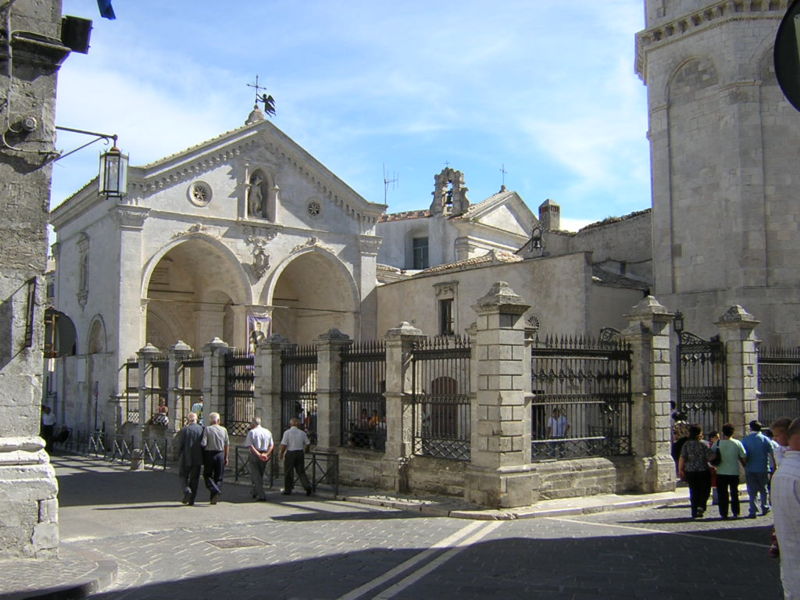
Modern Day Sancturary of St. Michael, the Archangel (Wikimedia Commons)

As these Normans appeared in transit, soon they began to interest the Lombard-led populations.  Several theories have been put forward by Norman chroniclers - Amatus of Montecassino, William of Apulia, and Leone Marsicanus (all in the eleventh and twelfth centuries).  Another theory comes from Radulfus Glaber in his earlier work, ca. 1030 (right after the events themselves occurred).

The earliest reported date for the arrival of Norman knights (engaged in combat) in southern Italy is 999.  In that year, according to several sources, Norman pilgrims returning from Jerusalem by way of Apulia stopped at Salerno, where they met with Prince Guaimar III, during which the city and its environs were attacked by Saracens demanding an annual tribute.  While Guaimar began to collect the tribute, the Normans upbraided him and his Lombard subjects for lack of bravery, and they assaulted the Saracen besiegers.  The Saracens fled, much booty was taken, and a Guaimar pleaded with the Normans to stay.  They refused but promised to show their riches to their compatriots in Normandy and to tell them of possible rewards for (mercenary) military service in Salerno. This account of the arrival of the Normans is sometimes called the Salerno tradition. This was first recorded by Amatus of Montecassino in his “Ystoire de li Normant” between 1071 and 1086, then was borrowed from Amatus by Peter the Deacon for his continuation of the “Chronicon Monasterii Casinensis” of Leo of Ostia, written in the early 12th century.  It is also mentioned by Orderic Vitalis in his "Historia Ecclesiastica".

William of Apulia had an alternative explanation from the years 1015-1016 in Gesta Roberti Wiscardi, dated 1088–1110. He does not mention Salerno in his work, though like Amatus he said that the first Normans to come to Italy were pilgrims. In his version, Norman pilgrims to Gargano encountered Melus, a member of the Lombard aristocracy of Apulia (in Bari) who was rebelling against the Byzantines. These Normans recognized the wealth of the region and the opportunities it offered for mercenaries.

Marsicanus, in the original version of his chronicle of Montecassino gives a briefer explanation that differs somewhat. He described the original revolt of Melus (ca. 1009) and then how he took refuge in Capua where he encountered forty Norman "in flight from the anger of their lord, the Count of Normandy" and persuades them to take part in his proposed invasion. Leone listed the leaders of the Normans as Gilbert Botericus, Rodulf of Tosny, Osmund, Rifinus and Stigand. In the later revision of the chronicle (by Leone or someone else), Amatus’ account is inserted almost verbatim while the list of the Norman leaders is omitted.  Amatus had in his account continued and described how the Count of Normandy had exiled a man called Gilbert Buatère for killing an individual called William, how Gilbert and his four brothers (Rudolf, Osmund, Rainulf and Asclettin) came to Italy and at Capua met Melus joining him in a new uprising. There are a variety of problems with this account especially the dates wherein Amatus appears to contract events that occurred over 20-30 years to imply they occurred in rapid succession. The latter two series of events are referred to as the Gargano traditiion.

The common elements in these accounts are: 1) Normans as pilgrims, 2) the role of political exiles, 3) the naming of Gilbert Buatère and 4) Norman involvement in Melus' second rebellion. Radulf's  version of the Normans’ arrival in "Radulfus Glaber Opera", edited by J.France, N. Bulst and P. Reynolds, Oxford Medieval Texts, Oxford, 1989, pages 96-101, refers to a man called Rodulf who had angered the count of Normandy, correctly named as Richard II (996-1026). Rodulf went with some companions to Rome where it was Pope Benedict VIII (1012-24) who recruited them for an attack on Apulia. Glaber’s suggestion that the pope was the instigator of or at least party to, the attack on Apulia in 1017 is supported by a contemporary French chronicler Adehemar of Chabannes: "Chronicon", edited by J. Chavanon, Paris, 1897, pages 178. Glaber also noted that news of their initial victories led to many other Normans leaving France and coming south. Certainly relations between the papacy and the patriarchate of Constantinople were poor in the 1010s as the papacy had been trying to reassert its authority, largely unsuccessfully, over the bishoprics of Byzantine Italy since the mid-tenth century.

It is possible that these stories are just the two or three tales that survived the times. They may include and be conflated with other stories known then but forgotten now. What we can ascertain is the following:

  1. The events of 999-1000 in Salerno of the Normans against the Saracens need not be dismissed as legend nor does it have to be related to the second rebellion of Melus in 1016-17. Moreover, this account does not invalidate other versions of the Normans’ arrival.
  2. William of Apulia's version of events should be seen as separate from the role of the Norman pilgrims at Salerno. There was a longstanding link between Normandy and the shrine at  Gargano. The presence of Melus at Gargano is likely. 
  3. Norman mercenaries were already in Italy in the early years of the eleventh century. They had been recruited by the abbots of Montecassino and Saint Vincent of Volturno around 1010. Amatus decribes how after the early battles in Apulia in 1017 more Normans "from Salerno" joined Melus’ army suggesting they were already there.
  4. Even the participation of Normans in Melus' first rebellion should not be ruled out. According to a document included in Finium agri Troiani descriptio faeta a Basilio Boiano Prol Ospdthario Catapano Italiae, a. 1019, XVIII, [in:] Syllabus Graecorum Membranarum, ed. F. Trinchera, Neapol 1865, p. 18 (Syllabus), the Byzantine general Basil Boioannes employed another group of Franks (the Byzantines always referred to Normans as Franks irrespective of their true ethnicity) and set them in city of Troia's fortress in the year 1019. What is especially interesting is that, these mercenaries must have lived in Italy for some time before they pledged allegiance to Basil, having served the counts of Ariano (ton areianiton kometon). These two events show that the Franks/Normans earned the reputation of superior soldiers very quickly and that gave them a
    This is the Byzantine Tower in Biccari, several kilometers from Troia. There was a similar structure in Troia built by Boiannes ca. 1017 as part of a network of towers and fortifications extending from northern Apulia to the Adriatic Sea. (Commune di Biccari Website)

    chance to serve under the Byzantine army. The contingent of mercenaries from Troia proved not only to be useful but also faithful. This is shown in another document concerning the same Franks/Normans, issued in 1024, by the same Basil (See Syllabus a. 1024, XX, p. 21), where the aforementioned soldiers served for considerable period of time (as mercenaries) and some of them might have been promoted.
      
  5. The involvement by Pope Benedict VIII with Norman mercenaries in Melus’ rebellion is feasible given growing problems between Rome and Constantinople.  
  6. Glaber also suggested that Landulf V, prince of Benevento was involved, while Amatus and Leone Marsicanus agree that Melus gathered his forces in Capua, presumably with the concurrence of its princes, the two cousins Pandulf II and Pandulf IV. Both Capua and Benevento, which were temporarily united between 1008 and 1014 has ambitions to recover land their predecessors had held in northern Apulia, so their involvement cannot be surprising.
So by 1015, there were a group of Normans living in southern Italy primarily and employed as mercenaries. They appeared to be in service with the various Lombard princes, the Byzantine army and the Roman church. It is likely that various groups of Normans (sometimes including non-Normans but all lumped together as "Franks") would be on opposite sides of service and they did not align with each other or any political or religious philosophy. But that would be about to change in the next decades.

What factors led to the emigration from Normandy to southern Italy?

The first factor that encouraged many contacts between France and Italy during the last quarter of the tenth and the first quarter of the eleventh century was pilgrimage.  Italy was the crossing point of every major pilgrimage route leading to the Holy Land. Normans became familiar with southern Italy, its politics, its culture and its opportunity for advancement.

The next contributing factor to the Norman migration to the south is the over-population of Normandy, but in the sense of “inheritance”.  The best example of this period is the sons of Tancred de Hauteville, whose reasons for venturing to Italy are suggested by Amatus of Montecassino, Geoffrey Malaterra and Orderic Vitalis. According to Amatus “these people [the Normans] had increased to such a number that the fields and orchards were not sufficient for producing the necessities of life for so many” (Amatus, I. 1.), while Malaterra adds that “the sons of Tancred [Hauteville] noticed that whenever their aging neighbors passed away, their heirs would fight amongst themselves for their inheritance resulting in the division of the patrimony – which had been intended to fall to the lot of a single heir – into portions that were too small. [...] Ultimately, … they came to Apulia, a province of Italy.”(Malaterra, 1. 5) Orderic Vitalis noted this through the last “speech” he put into the mouth of Robert Guiscard on his deathbed in July 1085: “We were born of poor and humble parents and left the barren (sterile) country of the Cotentin and homes which could not support us to travel to Rome.” (Orderic Vitalis, VII, p. 32) These accounts underline the fact that the division of the family patrimony was a serious issue in eleventh century Normandy. Inheritance dashed the aspirations of many younger sons for acquiring a piece of land for themselves. The type of “joint tenure” estate, where the younger sons were given a share of the patrimony under the control of their elder brother, which would satisfy the younger members of a family and discourage emigration became standard only in the late eleventh century.  (See E. Tabuteau, Transfers of Property in Eleventh-century Norman law, Chapel Hill, London, 1988, Cahen, La Regime Feodal, pp. 88-9, and Loud, “How Norman was the Norman Conquest of Southern Italy?”, p. 18) 

Next, political factors played an important role in the decision to leave for Italy. Many who did so were exiles, victims of ducal wrath due to their military or political opposition to him, although some were later pardoned by the duke and reinstated. Exile was a common tool of punishment used by the Richard II, known as the “Ullac” (the duke’s right to exile has Scandinavian origin – ullac - and it is first documented in the 1050s: Haskins, Norman Institutions, pp. 27-30; Bates, Normandy Before 1066, pp. 166-67; E. Van Houts, “L’Exil Dans l’Espace Anglo-Normand”, La Normandie et l’Angleterre au Moyen Age, ed. P.Bouet, V.Gazeau, CRAHM, Caen, 2001, pp. 117-27), against uncooperative members of the nobility, in which someone of note would have aroused the interest of the Duke himself.  But the driving force behind the expansion of the 1020s-50s to Italy was the political and social disturbances in Normandy itself and many parts of northern France after the break-down of Robert II’s regime in 1034, and especially during William II’s minority. (See D.C. Douglas, William the Conqueror, The Norman Impact upon England, (2nd ed.), Yale University Press, London, 1999, pp. 31-80; Bates, Normandy Before 1066, pp. 46-93)  

Other Normans were escaping the bitter conflicts between aristocratic families, during the crucial decades for the rise of aristocratic power (1035-55).  These years appear in great contrast to the period of relative stability and peace of the late tenth and early eleventh centuries in Normandy, a situation which had attracted political exiles from other parts of France actually, e.g. Anjou and Brittany, who would become leading members of the Norman aristocracy. The dramatic phase of Norman expansion began when the same type of territorial fragmentation and reorganization of family structures became pronounced within Normandy itself. (See Bates, Normandy Before 1066, p. 244.) 


Saturday, March 9, 2024

Part 3 - The Normans in Italy: The Normans Expand in Southern Italy: The Twelve Baronies – Melfi and the County of Apulia and Calabria

 Prologue

During the 1030 and 1040s, in addition to the intrigue between the Lombards and Byzantines, southern Italy was rocked by raids from Sicilian Muslims.  The areas affected were primarily the Byzantine ruled lands in nearby Calabria (and to a lesser extent, Lucania - now Basilicata - and Apulia).  Lupus reported that in 1031 (or 1032) Pothos Argyros (the catepan of Byzantine Italy) faced an invasion by the Emirate of Sicily. [See Mense Iunij comprehenderunt Sarraceni Cassianum. Cod. Andr. in terra Hydruntina, et tertio die mensis Iulij fecit proelium (a) Potho cum Sarracenis, et ceciderunt Graeci. Annales, 57.45–46] The Italian chroniclers report that the Muslims sacked Cassano allo Ionio (in Calabria) in June, and that, hurrying to confront them Argyros was defeated and killed. [See Felix, Wolfgang (1981). Byzanz und die islamische Welt im früheren 11. Jahrhundert (in German). Vienna: Verlag der Österreichischen Akademie der Wissenschaften, p.202] 

It was during this period that William “Iron Arm”, one of twelve sons of Tancred De Hauteville,  journeyed to Italy with his younger brother Drogo in the first half of the eleventh century (circa 1035), in response to requests for assistance (and the possibility of money and land) made by fellow Normans under Rainulf Drengot, by then the count of Aversa. This immigration was a transformative event in Italian history. (William and Drogo's half-brothers Robert Guiscard and Roger would also later immigrate). These De Hauteville would later conquer large parts of southern Italy, the island of Sicily and their sons would create the Norman Kingdom of Sicily, in the 12th century.

Emperor Michael IV ordered one of his top generals to Italy, George Maniakes, to succeed Agyros and stabilize the situation in Italy and in addition seek to drive the Muslims from Sicily, which they had held since the ninth century.  Maniakes brought a formidable mercenary army which included the Viking hero Harald Hardrada, Italian Lombards under Arduin and the recent Norman adventurer / immigrants under William Iron Arm. These latter troops were committed by Guaimar IV of Salerno

Invasion of Sicily and Revolt of the Lombards and Normans

From 1038 until 1040, Maniakes' diverse group defeated Arab forces in south-eastern Sicily, where the jewel in the crown was the city of Syracuse. It was in Sicily that William earned his nickname, "Iron Arm," by killing the emir of Syracuse with a sword in single combat. George Maniakes was satisfied to conquer Syracuse, controlling it from the coastal fortress that still bears his name. He was then appointed catapan of Italy but his victory was to prove fleeting.

Maniakes publicly insulted Arduin, the Lombard leader, who decided to withdraw back to peninsular Italy. William and the Normans decided to follow the Lombards, over a dispute on the sharing of the spoils of war. Back in Apulia the two were not always on the most amicable terms with each other or with the Byzantines. 

As a final insult, Harold and most of the Vikings also abandoned Maniakes. This made it difficult for Maniakes to hold his piece of Sicily. Maniakes likewise offended Stephen, his admiral, who had important connections back in Constantinople. In Maniakes' absence, the Emperor's crown had passed to Constantine IX. The general was recalled to the capital in 1042 and Syracuse (and Sicily) once again fell into Arab hands. Adding insult to injury, when Michael Dokeianos was appointed catapan of Italy, replacing Maniakes, he appointed Arduin as the military commander of the city of Melfi in Puglia.

In 1040, the Lombards of southern Italy revolted against the Byzantines, with the support of Norman mercenaries. In March, the rebels scored a first victory and killed Dokeianos, near the Olivento. In September 1041, they defeated the new Byzantine catepan, Exaugustus, the son of Basil Boioannes, and took him captive.  In February 1042, the original nominal leader, Atenulf, brother of the prince of Benevento, defected with the catepan's ransom money to the Byzantiness and was replaced by Argyrus, the son of Meles (of the original Lombard Rebellions). After some early successes, Argyrus also defected to the Byzantines. Agyrus apparently received a bribe from Constantine IX, and travelled to Constantinople and received the title of "Duke of Italy, Calabria, Sicily, and Paphlagonia."

In September 1042, the Normans elected their own leader, ignoring Arduin. The revolt, originally Lombard, had now become Norman in character and leadership. William Iron Arm was elected by the Normans as their count. Under him the Normans essentially conquered this part of northern Puglia from the Byzantines. William and the other leaders, chief among them Drogo and Peter, petitioned Guaimar IV, Prince of Salerno, for recognition of their conquests. They received the lands around Melfi as a fief and proclaimed Guaimar "Duke of Apulia and Calabria". At Melfi in 1043, Guaimar divided the region (except for Melfi itself) into twelve baronies for the benefit of the Norman leaders.

Amatus recorded that "the Normans divided among themselves" the lands at Melfi, following their victories against the Byzantines dated to 1041, and that:

  • William received Ascoli;

  • Drogo had Venosa;

  • Arnolin had Lavello;

  • Hugh Toutebove had Monopoli;

  • Rodulf had Canne;

  • Walter, Civitate;

  • Peter, Trani;

  • Rodulf son of Bebena, Sant´Arcangelo;

  • Tristan, Montepeloso;

  • Hervey, Grumento;

  • Asclettin, Acerenza; and

  • Rainfroi, Malarbine

adding that “Prince Guaimar of Salerno…invested each one of them,

Location of the Twelve Baronies of the Normans

William married Guida, daughter of Guy, duke of Sorrento, and niece of Guaimar, continuing a Norman strategy of using marriage to solidify political moves.

Melfi was the third of the Norman territories in Italy.  Melfi is located then in northern Apulia (present day Basilicata).  The lands at Melfi range from Monte Gargano near the Adriatic Sea to Monopoli (south of Bari).  Melfi gained its importance in the Middle Ages as a strategic point between areas controlled by the Byzantines – the Byzantine Themes of Lucania and Longbardia - and those controlled by the Lombards – the Duchy of Salerno, as a buffer territory, much like Ariano had been earlier.

County of Apulia and Calabria

William and Guaimar then began the conquest of Calabria (from the Byzantines) in 1044 but William was defeated near Taranto by Argyrus. He died in early 1046 and was succeeded by his brother Drogo. 

Drogo had fought on behalf of his brother in Apulia, seizing in 1045, Bovino from the Byzantines. In 1047, Drogo married Altrude of Salerno, a Lombard princess. In 1047, while the Emperor Henry III was visiting southern Italy, he received Drogo's homage and invested him with all the territory which he already controlled. After this Drogo began using the title "Duke and Master of all Italy and Count of all the Normans of Apulia and Calabria". [See Raoul Manselli. "Altavilla, Drogone d'". Dizionario Biografico degli Italiani, vol. 2, Alberto Ghisalberti (ed.) Rome: Istituto dell'Enciclopedia italiana, 1960] 

In 1051, Drogo was assassinated at Monteilaro, near Bovino, the victim of a Byzantine conspiracy of the Catepan, the Lombard, Argyrus, who was planning the reconquest of Apulia. Drogo was then succeeded by his brother Humphrey.

By this time, the Norman advances in southern Italy had alarmed Pope Leo and others. First, the Norman presence in Italy was more than just a case of upsetting the power balance, for many of the Italian locals did not take kindly to the Norman raiding and wished to respond in kind. Second, the instability brought about on the Norman side by the murder in unclear circumstances of Drogo. Third, Leo met Henry III, Holy Roman Emperor in Saxony, and asked for aid in curbing the growing Norman power. This was supported by the Italian and Lombard rulers in the south - the Prince of Benevento, Rudolf, the Duke of Gaeta, the Counts of Aquino and Teano, the Archbishop and the citizens of Amalfi — together with Lombards from Apulia, Molise, Campania, Abruzzo and Latium. The Pope had also another friendly power, the Byzantines now ruled by Constantine IX. At first, the Byzantines had tried to buy off the Normans and press them into service within their own largely mercenary army. So, the Byzantine commander, the Lombard Catepan of Italy Argyrus, offered money to disperse as mercenaries to the Eastern frontiers of the Empire, but the Normans rejected the proposal, implicitly stating that their aim was now the conquest of southern Italy

The sum of all this led to Leo establishing a coalition army of Germans, Lombards and Italians in 1053. Argyrus also contacted the Pope, and when Leo and his army moved from Rome to Apulia to engage the Normans in battle, a Byzantine army personally led by Argyros moved from Apulia with the same plan. The Normans understood the danger and collected all available men into a single army under the command of Humphrey as well as the Count of Aversa, Richard Drengot, others of the De Hauteville family, including Robert Guiscard, and the Count of Ariano, Gerardo, Guiscard's nephew (by marriage).

The Normans defeated the Papal army with Agyrus unable to reach the battle area in time to help them in the Battle of Civitate. After this defeat, Pope Leo did eventually acknowledge the Normans as the rulers of their domains in southern Italy. The Battle of Civitate proved to be a turning point in the fortunes of the Normans in Italy, who were able to win a victory despite their differences among themselves, solidifying their legitimacy in the process. Moreover, it was the first major victory for Robert Guiscard, who would eventually rise to prominence as the leader of the Normans. [Eads, Valerie. "Civitate, Battle of," in The Oxford Encyclopedia of Medieval Warfare and Military Technology. Edited by Clifford J. Rogers. Vol. 1. Oxford: University Press, 2010. p. 204.] In terms of its implications, the Battle of Civitate had the same long-term political ramifications as had the Battle of Hastings in England and Northern Europe, a reorientation of power and influence. [Norwich, John Julius. The Other Conquest. New York: Harper and Row, 1967. p. 96.]

Humphrey died in 1057 and was succeeded by Guiscard. Soon after his succession, likely in 1058, Guiscard separated from his wife because they were related within the prohibited degrees (apparently in a concession to the Papacy). The reformist Papacy, at odds with the Holy Roman Emperor (due to the Investiture Controversy) and the Roman nobility itself, resolved to recognize the Normans and secure them as allies. Therefore, at the Council of Melfi, in 1059, Pope Nicholas II invested Guiscard as duke of Apulia, Calabria, and Sicily.  Guiscard, now "by the Grace of God and St. Peter duke of Apulia and Calabria and, if either aid me, future lord of Sicily", agreed to hold his titles and lands by annual tribute to the Holy See and to maintain its cause.  In the next twenty years he was to undertake a series of conquests, winning his Sicilian dukedom.

Depiction of Robert Guiscard

The Drengots 

A series of deaths during the period of 1054–1056, that of Pope Leo with no immediate successor, of Constantine IX Monomachos leaving Constantinople in internal strife and Emperor Henry III leaving a child heir, gave the Normans a near free hand in Southern Italy. [G.A. Loud, The Age of Robert Guiscard: Southern Italy and the Norman Conquest (New York: Longman, 2000), p. 120] Richard (who was Guiscard's brother-in-law, took advantage of this. Richard had been constantly seeking territorial expansion through war against his Lombard neighbors, Pandulf VI of Capua and Guaimar's son and successor, Gisulf II of Salerno. [John Julius Norwich, The Normans in the South 1016-1130 (London: Longmans, 1967), pp. 108–09] He pushed back the borders of the latter until there was little left of the once great principality but the city of Salerno itself and when the (weak) prince of Capua died in 1057, he besieged Capua and took the princely title (1058) from Pandulf's brother, Landulf VIII, but left the city in Lombard hands for at least four years more, until 1062. [Norwich, 1967, pp. 108–09]

In 1059, the future Pope Gregory VII, then a high-ranking member of the Papal Curia, travelled to Capua to enlist for aid on behalf of the reforming Pope Nicholas II against the antipope Benedict X. [Norwich, 1967, p. 124] Soon, Richard was besieging Benedict and, in 1059, Nicholas convened a synod at Melfi where he confirmed Richard as count of Aversa and prince of Capua at the same time as investing Guiscard as duke of Apulia, Calabria, and Sicily. [Norwich, 1967, p. 124] Richard and Guiscard swore allegiance to the papacy and respect for papal territory, completely transforming the political loyalties of the south of Italy and removing the few remaining independent Greek and Lombard princes and the Holy Roman emperor from the political picture. [Norwich, 1967, p. 124]

Richard I, Prince of Capua, making donation, miniature from Sant'Angelo's Register in Formis, manuscript, Italy, 12th century

Epilogue

The conquest of southern Italy thus fell into three distinct stages. First, up to the early 1040s the Normans acted as mercenaries, selling their services to almost every power in the south, except for the Muslims, “fighting for the purpose of gain” in Malaterra’s succinct phrase. (“Causa militari aliquid lucrandi”, Malaterra, i.6, p. 10.) This led to the Norman enclaves of Ariano and Aversa.

From 1042 onwards they acted in their own right, extending their operations from the Lombard zone (Ariano) into Apulia (at Melfi and elsewhere), and in the 1040s and 1050s employment turned into conquest. The capture of Capua in 1058 and the investiture of the Norman leaders Robert Guiscard and Richard I of Aversa by the pope in 1059 as, respectively, duke of Apulia and prince of Capua effectively closed this phase, even though not all of southern Italy was yet in Norman hands. The papal investiture was a sign that the Normans were there to stay, and it recognized that by then their takeover was inevitable.  

The third phase was one of consolidation on the mainland, defeating the last bastions of Byzantine rule in Apulia and Calabria, annexing the remaining Lombard led duchies and, then combined with a new enterprise, the conquest of the island of Sicily in 1061.


The Long Strike of 1875 (and the rise of the Molly Maguires)

This was a labor strike by anthracite coal miners in northeast Pennsylvania which led to the dissolution of the first truly effective miners...