Showing posts with label Drengot. Show all posts

Saturday, March 9, 2024

Part 3 - The Normans in Italy: The Normans Expand in Southern Italy: The Twelve Baronies – Melfi and the County of Apulia and Calabria

 Prologue

During the 1030 and 1040s, in addition to the intrigue between the Lombards and Byzantines, southern Italy was rocked by raids from Sicilian Muslims.  The areas affected were primarily the Byzantine ruled lands in nearby Calabria (and to a lesser extent, Lucania - now Basilicata - and Apulia).  Lupus reported that in 1031 (or 1032) Pothos Argyros (the catepan of Byzantine Italy) faced an invasion by the Emirate of Sicily. [See Mense Iunij comprehenderunt Sarraceni Cassianum. Cod. Andr. in terra Hydruntina, et tertio die mensis Iulij fecit proelium (a) Potho cum Sarracenis, et ceciderunt Graeci. Annales, 57.45–46] The Italian chroniclers report that the Muslims sacked Cassano allo Ionio (in Calabria) in June, and that, hurrying to confront them Argyros was defeated and killed. [See Felix, Wolfgang (1981). Byzanz und die islamische Welt im früheren 11. Jahrhundert (in German). Vienna: Verlag der Österreichischen Akademie der Wissenschaften, p.202] 

It was during this period that William “Iron Arm”, one of twelve sons of Tancred De Hauteville,  journeyed to Italy with his younger brother Drogo in the first half of the eleventh century (circa 1035), in response to requests for assistance (and the possibility of money and land) made by fellow Normans under Rainulf Drengot, by then the count of Aversa. This immigration was a transformative event in Italian history. (William and Drogo's half-brothers Robert Guiscard and Roger would also later immigrate). These De Hauteville would later conquer large parts of southern Italy, the island of Sicily and their sons would create the Norman Kingdom of Sicily, in the 12th century.

Emperor Michael IV ordered one of his top generals to Italy, George Maniakes, to succeed Agyros and stabilize the situation in Italy and in addition seek to drive the Muslims from Sicily, which they had held since the ninth century.  Maniakes brought a formidable mercenary army which included the Viking hero Harald Hardrada, Italian Lombards under Arduin and the recent Norman adventurer / immigrants under William Iron Arm. These latter troops were committed by Guaimar IV of Salerno

Invasion of Sicily and Revolt of the Lombards and Normans

From 1038 until 1040, Maniakes' diverse group defeated Arab forces in south-eastern Sicily, where the jewel in the crown was the city of Syracuse. It was in Sicily that William earned his nickname, "Iron Arm," by killing the emir of Syracuse with a sword in single combat. George Maniakes was satisfied to conquer Syracuse, controlling it from the coastal fortress that still bears his name. He was then appointed catapan of Italy but his victory was to prove fleeting.

Maniakes publicly insulted Arduin, the Lombard leader, who decided to withdraw back to peninsular Italy. William and the Normans decided to follow the Lombards, over a dispute on the sharing of the spoils of war. Back in Apulia the two were not always on the most amicable terms with each other or with the Byzantines. 

As a final insult, Harold and most of the Vikings also abandoned Maniakes. This made it difficult for Maniakes to hold his piece of Sicily. Maniakes likewise offended Stephen, his admiral, who had important connections back in Constantinople. In Maniakes' absence, the Emperor's crown had passed to Constantine IX. The general was recalled to the capital in 1042 and Syracuse (and Sicily) once again fell into Arab hands. Adding insult to injury, when Michael Dokeianos was appointed catapan of Italy, replacing Maniakes, he appointed Arduin as the military commander of the city of Melfi in Puglia.

In 1040, the Lombards of southern Italy revolted against the Byzantines, with the support of Norman mercenaries. In March, the rebels scored a first victory and killed Dokeianos, near the Olivento. In September 1041, they defeated the new Byzantine catepan, Exaugustus, the son of Basil Boioannes, and took him captive.  In February 1042, the original nominal leader, Atenulf, brother of the prince of Benevento, defected with the catepan's ransom money to the Byzantiness and was replaced by Argyrus, the son of Meles (of the original Lombard Rebellions). After some early successes, Argyrus also defected to the Byzantines. Agyrus apparently received a bribe from Constantine IX, and travelled to Constantinople and received the title of "Duke of Italy, Calabria, Sicily, and Paphlagonia."

In September 1042, the Normans elected their own leader, ignoring Arduin. The revolt, originally Lombard, had now become Norman in character and leadership. William Iron Arm was elected by the Normans as their count. Under him the Normans essentially conquered this part of northern Puglia from the Byzantines. William and the other leaders, chief among them Drogo and Peter, petitioned Guaimar IV, Prince of Salerno, for recognition of their conquests. They received the lands around Melfi as a fief and proclaimed Guaimar "Duke of Apulia and Calabria". At Melfi in 1043, Guaimar divided the region (except for Melfi itself) into twelve baronies for the benefit of the Norman leaders.

Amatus recorded that "the Normans divided among themselves" the lands at Melfi, following their victories against the Byzantines dated to 1041, and that:

  • William received Ascoli;

  • Drogo had Venosa;

  • Arnolin had Lavello;

  • Hugh Toutebove had Monopoli;

  • Rodulf had Canne;

  • Walter, Civitate;

  • Peter, Trani;

  • Rodulf son of Bebena, Sant´Arcangelo;

  • Tristan, Montepeloso;

  • Hervey, Grumento;

  • Asclettin, Acerenza; and

  • Rainfroi, Malarbine

adding that “Prince Guaimar of Salerno…invested each one of them,

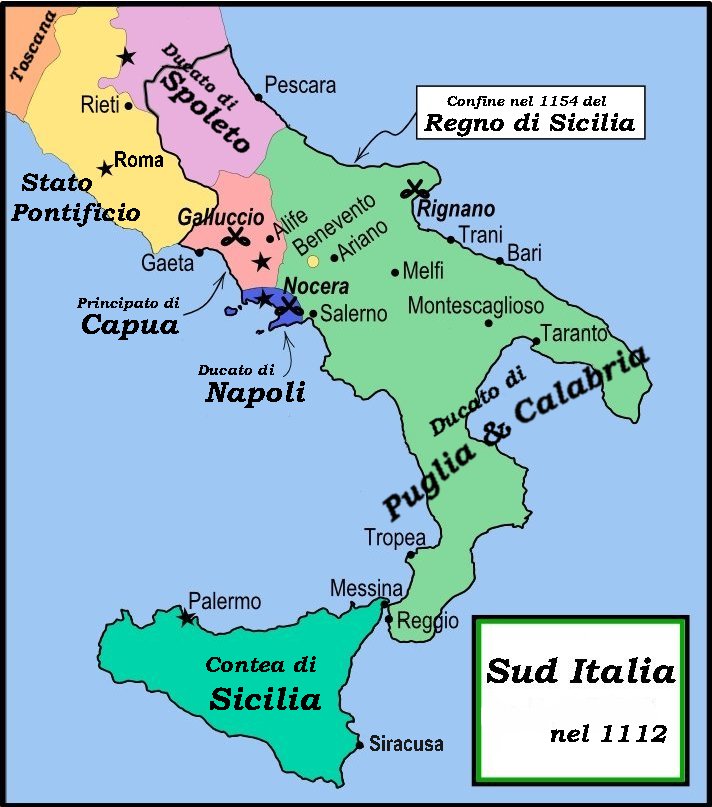
Location of the Twelve Baronies of the Normans

William married Guida, daughter of Guy, duke of Sorrento, and niece of Guaimar, continuing a Norman strategy of using marriage to solidify political moves.

Melfi was the third of the Norman territories in Italy.  Melfi is located then in northern Apulia (present day Basilicata).  The lands at Melfi range from Monte Gargano near the Adriatic Sea to Monopoli (south of Bari).  Melfi gained its importance in the Middle Ages as a strategic point between areas controlled by the Byzantines – the Byzantine Themes of Lucania and Longbardia - and those controlled by the Lombards – the Duchy of Salerno, as a buffer territory, much like Ariano had been earlier.

County of Apulia and Calabria

William and Guaimar then began the conquest of Calabria (from the Byzantines) in 1044 but William was defeated near Taranto by Argyrus. He died in early 1046 and was succeeded by his brother Drogo. 

Drogo had fought on behalf of his brother in Apulia, seizing in 1045, Bovino from the Byzantines. In 1047, Drogo married Altrude of Salerno, a Lombard princess. In 1047, while the Emperor Henry III was visiting southern Italy, he received Drogo's homage and invested him with all the territory which he already controlled. After this Drogo began using the title "Duke and Master of all Italy and Count of all the Normans of Apulia and Calabria". [See Raoul Manselli. "Altavilla, Drogone d'". Dizionario Biografico degli Italiani, vol. 2, Alberto Ghisalberti (ed.) Rome: Istituto dell'Enciclopedia italiana, 1960] 

In 1051, Drogo was assassinated at Monteilaro, near Bovino, the victim of a Byzantine conspiracy of the Catepan, the Lombard, Argyrus, who was planning the reconquest of Apulia. Drogo was then succeeded by his brother Humphrey.

By this time, the Norman advances in southern Italy had alarmed Pope Leo and others. First, the Norman presence in Italy was more than just a case of upsetting the power balance, for many of the Italian locals did not take kindly to the Norman raiding and wished to respond in kind. Second, the instability brought about on the Norman side by the murder in unclear circumstances of Drogo. Third, Leo met Henry III, Holy Roman Emperor in Saxony, and asked for aid in curbing the growing Norman power. This was supported by the Italian and Lombard rulers in the south - the Prince of Benevento, Rudolf, the Duke of Gaeta, the Counts of Aquino and Teano, the Archbishop and the citizens of Amalfi — together with Lombards from Apulia, Molise, Campania, Abruzzo and Latium. The Pope had also another friendly power, the Byzantines now ruled by Constantine IX. At first, the Byzantines had tried to buy off the Normans and press them into service within their own largely mercenary army. So, the Byzantine commander, the Lombard Catepan of Italy Argyrus, offered money to disperse as mercenaries to the Eastern frontiers of the Empire, but the Normans rejected the proposal, implicitly stating that their aim was now the conquest of southern Italy

The sum of all this led to Leo establishing a coalition army of Germans, Lombards and Italians in 1053. Argyrus also contacted the Pope, and when Leo and his army moved from Rome to Apulia to engage the Normans in battle, a Byzantine army personally led by Argyros moved from Apulia with the same plan. The Normans understood the danger and collected all available men into a single army under the command of Humphrey as well as the Count of Aversa, Richard Drengot, others of the De Hauteville family, including Robert Guiscard, and the Count of Ariano, Gerardo, Guiscard's nephew (by marriage).

The Normans defeated the Papal army with Agyrus unable to reach the battle area in time to help them in the Battle of Civitate. After this defeat, Pope Leo did eventually acknowledge the Normans as the rulers of their domains in southern Italy. The Battle of Civitate proved to be a turning point in the fortunes of the Normans in Italy, who were able to win a victory despite their differences among themselves, solidifying their legitimacy in the process. Moreover, it was the first major victory for Robert Guiscard, who would eventually rise to prominence as the leader of the Normans. [Eads, Valerie. "Civitate, Battle of," in The Oxford Encyclopedia of Medieval Warfare and Military Technology. Edited by Clifford J. Rogers. Vol. 1. Oxford: University Press, 2010. p. 204.] In terms of its implications, the Battle of Civitate had the same long-term political ramifications as had the Battle of Hastings in England and Northern Europe, a reorientation of power and influence. [Norwich, John Julius. The Other Conquest. New York: Harper and Row, 1967. p. 96.]

Humphrey died in 1057 and was succeeded by Guiscard. Soon after his succession, likely in 1058, Guiscard separated from his wife because they were related within the prohibited degrees (apparently in a concession to the Papacy). The reformist Papacy, at odds with the Holy Roman Emperor (due to the Investiture Controversy) and the Roman nobility itself, resolved to recognize the Normans and secure them as allies. Therefore, at the Council of Melfi, in 1059, Pope Nicholas II invested Guiscard as duke of Apulia, Calabria, and Sicily.  Guiscard, now "by the Grace of God and St. Peter duke of Apulia and Calabria and, if either aid me, future lord of Sicily", agreed to hold his titles and lands by annual tribute to the Holy See and to maintain its cause.  In the next twenty years he was to undertake a series of conquests, winning his Sicilian dukedom.

Depiction of Robert Guiscard

The Drengots 

A series of deaths during the period of 1054–1056, that of Pope Leo with no immediate successor, of Constantine IX Monomachos leaving Constantinople in internal strife and Emperor Henry III leaving a child heir, gave the Normans a near free hand in Southern Italy. [G.A. Loud, The Age of Robert Guiscard: Southern Italy and the Norman Conquest (New York: Longman, 2000), p. 120] Richard (who was Guiscard's brother-in-law, took advantage of this. Richard had been constantly seeking territorial expansion through war against his Lombard neighbors, Pandulf VI of Capua and Guaimar's son and successor, Gisulf II of Salerno. [John Julius Norwich, The Normans in the South 1016-1130 (London: Longmans, 1967), pp. 108–09] He pushed back the borders of the latter until there was little left of the once great principality but the city of Salerno itself and when the (weak) prince of Capua died in 1057, he besieged Capua and took the princely title (1058) from Pandulf's brother, Landulf VIII, but left the city in Lombard hands for at least four years more, until 1062. [Norwich, 1967, pp. 108–09]

In 1059, the future Pope Gregory VII, then a high-ranking member of the Papal Curia, travelled to Capua to enlist for aid on behalf of the reforming Pope Nicholas II against the antipope Benedict X. [Norwich, 1967, p. 124] Soon, Richard was besieging Benedict and, in 1059, Nicholas convened a synod at Melfi where he confirmed Richard as count of Aversa and prince of Capua at the same time as investing Guiscard as duke of Apulia, Calabria, and Sicily. [Norwich, 1967, p. 124] Richard and Guiscard swore allegiance to the papacy and respect for papal territory, completely transforming the political loyalties of the south of Italy and removing the few remaining independent Greek and Lombard princes and the Holy Roman emperor from the political picture. [Norwich, 1967, p. 124]

Richard I, Prince of Capua, making donation, miniature from Sant'Angelo's Register in Formis, manuscript, Italy, 12th century

Epilogue

The conquest of southern Italy thus fell into three distinct stages. First, up to the early 1040s the Normans acted as mercenaries, selling their services to almost every power in the south, except for the Muslims, “fighting for the purpose of gain” in Malaterra’s succinct phrase. (“Causa militari aliquid lucrandi”, Malaterra, i.6, p. 10.) This led to the Norman enclaves of Ariano and Aversa.

From 1042 onwards they acted in their own right, extending their operations from the Lombard zone (Ariano) into Apulia (at Melfi and elsewhere), and in the 1040s and 1050s employment turned into conquest. The capture of Capua in 1058 and the investiture of the Norman leaders Robert Guiscard and Richard I of Aversa by the pope in 1059 as, respectively, duke of Apulia and prince of Capua effectively closed this phase, even though not all of southern Italy was yet in Norman hands. The papal investiture was a sign that the Normans were there to stay, and it recognized that by then their takeover was inevitable.  

The third phase was one of consolidation on the mainland, defeating the last bastions of Byzantine rule in Apulia and Calabria, annexing the remaining Lombard led duchies and, then combined with a new enterprise, the conquest of the island of Sicily in 1061.


Friday, March 1, 2024

Part 2 - The Normans in Italy: The Normans Gain a Foothold in Southern Italy - The County of Ariano - The County of Aversa

And now for some history completely different. We all know about the Norman invasion of England in 1066. But there was another Norman conquest during this same time frame in southern Italy. It wasn't really an invasion; small groups of Normans, best described as soldiers of fortune, were heading to Salerno and Apulia (Puglia). They were either on their own or hired by the rulers of southern Italy - Lombards or the eastern Roman Empire of Constantinople. This is how it all began...

The First Lombard Rebellion

The story of the first Norman territory to be established in Italy actually starts circa 1010.  This was the time of the first rebellion led by Melus of Bari and his brother in law, Dattus (Lombards) against the Eastern Romas (later called Byzantines). Leone Marsicanus, in the original version of his chronicle of Monte Cassino gives a brief explanation of the original revolt of Melus and how he took refuge in Capua where he encountered forty Normans "in flight from the anger of their lord, the Count of Normandy" and persuades them to take part in his proposed rebellion. Leone listed the leaders of these Normans as Gilbert Botericus, Rodulf of Tosny, Osmund, Rifinus and Stigand.

Basil Mesardonites was the Catapan (a senior Byzantine military rank and political office) of Italy, representing the Byzantine Emperor there, from 1010 until 1016 or 1017. He succeeded the previous catapan John Kourkouas, who died fighting against Meles' rebellion. Basil and Leo Tornikios Kontoleon, the strategos (military general) of Cephalonia, besieged the rebels in Bari. The Greek citizens of the city negotiated with Basil and forced the Lombard leaders, Melus and Dattus, to flee. Basil entered the city on June 11, 1011 and re-established Byzantine authority.

Basil sent the family of Melus to Constantinople. Basil then allied to the Byzantines as many Lombard principalities as possible in an attempt to prevent future unrest. He visited Salerno in October, where Prince Guaimar III was nominally a Byzantine vassal. He then moved on to Monte Cassino, which monastery was sheltering Dattus on its lands. Basil nonetheless confirmed all the privileges of the monastery over its property in Greek territory. The abbot there, Atenulf, was a brother of the prince of Capua, Pandulf IV. The monastery then promptly expelled Dattus and he fled north into papal territory. Basil held the Byzantine rule in peace until his death in 1016 and was replaced by Leo.

Norman mercenaries were already in Italy in the early years of the eleventh century. They had been recruited by the abbots of Monte Cassino and Saint Vincent of Volturno around 1010.  The participation of Normans in Melus' first rebellion are an example of that. According to a document included in Finium agri Troiani descriptio faeta a Basilio Boiano Prol Ospdthario Catapano Italiae, a. 1019, XVIII, [in:] Syllabus Graecorum Membranarum, ed. F. Trinchera, Neapol 1865, p. 18 (Syllabus), the Byzantine general Basil Boioannes employed another group of Franks (the Byzantines always referred to Normans as Franks irrespective of their true ethnicity) and set them in the city of Troia's fortress in the year 1019. What is especially interesting is that the mercenaries must have lived in Italy for some time before they pledged allegiance to Basil, they served the counts of Ariano (ton areianiton kometon). These two events show that the Franks/Normans earned the reputation of excellent soldiers very quickly and that gave them a chance to serve under the Byzantine army. The contingent of mercenaries from Troia proved not only to be useful but also faithful. This is shown in another document concerning the same Franks/Normans, issued in 1024, by the same Basil (See Syllabus a. 1024, XX, p. 21), where the aforementioned soldiers served for considerable period of time (as mercenaries) and some of them might have been promoted. 

The Second Lombard Rebellion

The traditional story of the first Norman territory in southern Italy begins with the Normans (the Drengot family) assisting Melus and Dattus in the second rebellion of 1017. (Referred to as the Gargano Tradition).  Most of this comes from Amatus’ account of “Ystoire de li Normant” between 1071 and 1086, then borrowed from Amatus by Peter the Deacon for his continuation of the “Chronicon Monasterii Casinensis” of Leo of Ostia, written in the early 12th century.  It is also mentioned by Orderic Vitalis in his "Historia Ecclesiastica".) There he petitioned Gilbert Buatère of the Drengot family (and his brothers - Osmond, Rudolf, Rainulf and Asclettin, some similar names from the First Rebellion above) and a band of Norman exiles or immigrants to aid in his rebellion, assuring them of the ease of victory and the abundance of spoils. The identification of some of these Normans may be the same as those identified above by Leone. Of course, some appear to be different. Apparently all were agreeable and joined with the Lombard forces under Melus at Capua or Benevento and marched into Apulia immediately, trying to catch the Byzantines off-guard.

Leo was the Catapan of Italy in 1017 when Melus of Bari again rose in revolt, this time clearly with a band of Normans. Leo sent his military general, Leo Passianos, with an army against him. Passianos and Melus met on the Fortore River at Arenula. The battle was either indecisive (according to William of Apulia) or a victory for Melus (Leo of Ostia). Tornikios then took command himself and led the Byzantines into a second encounter near Civita. This second battle was another victory for Melus, though Lupus Protospatharius and the anonymous chronicler of Bar call it a defeat. A third battle, a decisive victory for Melus, occurred at Vaccaricia, near the future site of Troia. The entire Apulian region from the Fortore River to Trani had fallen to Melus and in September, Tornikios was relieved of his duties in favor of Boiannes, another Byzantine general.

Boiannes garnered a large force of reserves and a contingent of the Varangian (Royal) Guard (Vikings) from Emperor Basil II. He met the Lombard and Norman army on the Ofanto at the site of the defeat dealt to the Romans by Hannibal in 216 BCE: Cannae. This second battle of Cannae was a disaster both for Meles and the Normans, who lost their leaders, Gilbert and his brother Osmond.  Melus fled to the "Samnite lands" of the Papal States (Amatus) and Dattus to Monte Cassino. A small group of Normans (probably between 10-50) limped back towards Capua and Salerno.

Lombard areas shown in red, battles of Fortore, Civita, Vaccaricia (in black) and Cannae in black (near Barletta)

In the later revision of the chronicle (see above revised by Leone or someone else), Amatus’ account is inserted almost verbatim while the list of the Norman leaders is omitted. 

Henry II Invades Southern Italy

This time, Melus eventually fled northwards to Germany and ended up at the imperial court of the Holy Roman Emperor Henry II. Though honored there (Meles was given the empty title Duke of Apulia by the emperor), he died two years later.  Meanwhile, in 1020, Boiannes, and his ally, Pandulf IV of Capua, marched on Monte Cassino and took it aided by Dattus.  However later at Bari in June 1021, Dattus was executed tied up in a sack with a monkey, a rooster, and a snake and tossed into the sea (the so-called mazzeratura, similar to the ancient Roma Poena cullei). This atrocity (and the general military successes of Boiannes) prompted a quick Western response, and a large army under Emperor Henry II who marched south to besiege the new Byzantine fortress at Troia. Troia was built by Boiannes ca. 1017 as part of a network of towers and fortifications extending from northern Apulia to the Adriatic Sea.

In the intervening years between 1018 and 1021, the Normans who survived the Battle at Cannae remained in Apulia or drifted to and in Benevento or Capua. The three other Drengot brothers, Asclettin, Rudolf and Rainulf, apparently settled near Ariano Irpino, but Rudolf eventually returned to Normandy. (Rudolph had accompanied Meles to Germany to meet Emperor Henry II). It is believed that Rudolph also met with the pope. He returned to the south with the emperor's invasion force, after Melus' death in 1022, and was installed at Comino under one of Melus' nephews, a count. Rudolph then led some Normans back to Normandy, not to be heard of again.

In 1022, as Henry II set out down the Adriatic coast for southern Italy commanding a large force to avenge the execution of Dattus, he sent Archbishop Pilgrim of Cologne ahead with a slightly smaller army along the Tyrrhenian littoral with the objective of subjugating the Principality of Capua (and Benevento), which was accomplished.  A third army, smaller still, under the command of Patriarch Poppo of Aquileia went through the Apennines to join Henry II in besieging the Byzantine fortress of Troia.  Although Pandulf IV of Capua was captured and Henry extracted oaths of allegiance from both Capua and the Principality of Salerno, all three of Henry II's armies failed to take Troia.

The contingent of Norman mercenaries from Troia (under the Byzantines) proved not only to be useful but also faithful.  Boioannes granted the town privileges for its loyalty, and the Normans acquired a reputation as Southern Europe's premier mercenaries.  See the document, concerning the same Franks, issued in 1024 (see Finium agri Troiani descriptio faeta a Basilio Boiano Prol Ospdthario Catapano Italiae, a. 1024, XX, [in:] Syllabus Graecorum Membranarum, ed. F. Trinchera, Neapol 1865, p. 21), by the same Basil Boioannes. This shows that the mentioned soldiers served for considerable period of time (as mercenaries) and some of them might have been promoted.  It is not known if other Normans allied with Henry’s armies, but this cannot be ruled out.

Rise of Independent Norman Power

County of Ariano

The period prior to (and after) this incursion by Henry II into Italy, saw the rise of independent Norman power, under Rainulf and Asclettin (both Drengot and others unknown) who had withdrawn with the remnants of the band from Apulia (from the Battle of Cannae and the siege of Troia) to Campania, where they were able to take advantage of dissension among the comparatively undisciplined Lombard lords and the weakness of the Byzantines, absent their large army. The Normans found they could play off Lombard versus Byzantine and vice versa, as well as Lombard versus Lombard. Norman reinforcements and local miscreants migrating from Normandy found a welcome there and swelled the number of soldiers of fortune at their command. Their Norman language and Norman customs welded a disparate group into some semblance of a homeland.  Normans on the winning side often used their leverage as irreplaceable allies to secure the release of their brethren on the losing side.  The Byzantines, the Pope, the Emperor, and the Lombard princes would all hire Norman mercenaries to fight against the other factions for them.


Ariano near Benevento in modern day Campania. There is research that indicates this was a Norman County recognized (in 1022) by Henry II after his incursion into southern Italy and after the Siege of (Byzantine) Troia (Wikimedia Commons)

The first freelance Norman gains have been identified by some as at Ariano (See Normans and the Normans’ Edge: Peoples, Polities and Identities on the Frontiers of Medieval Europe Edited by Keith Stringer, Andrew Jotischky, Copyright Year 2020, Published June 30, 2021 by Routledge, Chapter 6. South Italian Normans and the Crusader States in the Twelfth Century by Ewan Johnson and Andrew Jotischky).  During this boiling cauldron of southern Italian history, the Norman county of Ariano was formally recognized in 1022 by Henry II as king of Italy (See D’Onofrio, Mario, (a cura di), I Normanni. Popolo d'Europa 1030-1200, Roma, 28 gennaio - 30 aprile 1994, Venezia, Marsilio, 1994, pp. 177-181 and D’Amato, Raffaele,  e Salimbeti, Andrea, The Normans in Italy 1016–1194, Bloomsbury Publishing, 2020, p. 7). 

Location of Ariano in blue, between Benevento (green) and Byzantine fortresses in Troia and vicinity (red). Cannae shown in black

However, the identity of these first Norman counts remains unknown, but, by 1050 Count Ubberto (Umberto) and his son Gerardo di Buonalbergo are identified (see Cuozzo, Errico, L'unificazione normanna e il regno normanno-svevo, in Storia del Mezzogiorno, II/ 1, Il Medioevo. Napoli, Edizioni del Sole, 1989, pp. 593-825, in part. pp. 618-619 and Charles Cawley's Medieval Lands, the encyclopaedia of territories in the medieval western world and the royal and noble families which ruled them). These counts were not the Drengot family but later events suggest they were related to the second De Hauteville family (not yet in Italy) or the ruling Norman Dukes in France.  In this phase the grancontea reached its maximum extent: its boundaries extended to the limits of Avellino and Benevento on the west and north to near the city of Troia on the east, becoming a buffer between Byzantine and Lombard (and Papal) territory.

The importance of these Ariano lords can only be seen in the interactions they, decades later, have with Robert Guiscard.  The first mention of Gerardo is in relation to a significant episode, which took place between 1047 and 1051. Gerardo introduced himself to Robert of the De Hauteville family, then in Puglia with his brother Drogo. Gerardo offered him the marriage of his (paternal) aunt Alberada and proposed to place himself at his side, with 200 horsemen "pour aquester Calabre" (to take possession of Calabria). The story is that Gerardo would have been the first to address Robert as, "quasi per iocum" (a term of endearment), with the nickname of “Guiscard” (wise or wily).  Moreover, Gerardo reveals the position of significance that he has already at that moment - 200 knights following him, on an equal footing with one of the major members of the De Hauteville clan.

Side Notes: (1) Alberada was the daughter of Alice of Normandy (and thus a granddaughter of Richard II, the Duke of Normandy) and Renaud I, the Count of Burgundy. In 1058, Pope Nicholas II strengthened existing canon law against consanguinity. Alice's sister Fressende was Robert Guiscard's mother. Thus, Alberada was Guiscard's first cousin, once removed.  Guiscard repudiated Alberada on that basis, in order to make a then-more advantageous marriage to Sichelgaita, a Lombard, the sister of Prince Gisulf II of Salerno. (2) The number of Norman knights in the Battle of Cannae (1018) has been estimated as about two hundred and fifty, of which about ten survived (according to The Rulers of the South by Francis Marion Crawford published by MacMillan & Co. Ltd. New York and London 1900, p. 133). But by the end the middle of the next decade there were hundreds (not only engaging in free-lance brigandry in Apulia, Benevento and Capua but also fighting for the Byzantines) and by the middle of their fourth decade in Italy, it is believed that about 500 troops where there (see article The Normans in Southern Italy by Georgios Theotokis, Ph.D History 2010, University of Glasgow) after another decade of conscripting mercenaries and fortune hunters from of France and Italy.

 County of Aversa

Although the County of Ariano may have been the first Norman land in Italy and somewhat successful, it was not the most recognized Norman land.  That honor belongs to the County of Aversa which was established in 1030. Aversa was considered for a millennium, the first of the Norman territories in the Mediterranean.  Aversa is located on the Tyrrhenian Sea, north the city of Naples, from which it is separated by only 5 kilometers, and south of Capua.

As noted above in the years during the Second Lombard Rebellion, Normans were also allied with Lombards. When Henry II invaded southern Italy, in 1024, Pilgrim, Archbishop of Cologne, was besieging Capua on behalf of Emperor Henry II, Sergius IV. Duke of Naples was nominally a Byzantine vassal, like his father before him.  In 1024, he submitted to Pilgrim, though his own duchy was not threatened.  By this he acquired a reputation for weakness in the eyes of Prince Pandulf IV of Capua (Wolf of the Abruzzi), who had himself been defeated by Pilgrim and taken prisoner.  

In 1026, Pandulf IV, returned from captivity, besieged his old capital, now ruled by an unrelated Pandulf V, the count of Teano.  Pandulf IV allied himself with Rainulf Drengot at this time.  Basil Boiannes, the Greek catapan of Italy, negotiated a surrender and gave Pandulf V safe conduct to Naples, where Sergius offered him asylum.  With this, Sergius further incurred Pandulf IV's enmity.  

In the next year, after Sergius' ally Boiannes was recalled, Pandulf IV attacked Naples and quickly captured it.  Pandulf V fled to Rome and Sergius went into hiding.  For Sergius, however, fortune reversed itself when Pandulf IV was abandoned by his Norman ally, Rainulf in 1029. Sergius and the Duke of Gaeta, John V, sent an embassy to the Norman to ask his assistance in regaining the Neapolitan duchy.  With Rainulf's help, Pandulf IV was ousted from Naples and Sergius reinstated.

After this series of events, in 1030, the County of Aversa was ceded to Rainulf Drengot who was invested as count by Sergius IV of Naples and confirmed by Holy Roman Emperor Conrad II in 1037. Rainulf married Duke Sergius’ sister.  In 1034, this first wife died, and Rainulf then married the daughter of the duke of Amalfi (John II), who was also the niece of Sergius' inveterate enemy, Pandulf IV.  He expanded Aversa at the expense of the abbey of Monte Cassino (lands under papal suzerainty in Benevento).

County of Aversa (arrow)

By offering a generous conditions of asylum for the persecuted, Rainulf enlarged the power and importance of his once little fief, which became one of the bases from which the Normans later forged a consolidated state in Sicily and Italy - the Kingdom of Sicily. But it was during this phase that Norman soldiers of fortune from France and joined the locals, who found a welcome in Ranulf's camp with no questions asked, swelled Ranulf's numbers. In 1035, the same year William the Conqueror would become Duke of Normandy, Tancred De Hauteville's three eldest sons (William "Iron Arm", Drogo and Humphrey) arrived in Aversa from Normandy. Meanwhile at Ariano, other Normans from France swelled the county of Ariano in a similar manner. After vanquishing the Byzantines in battle in 1038, Drengot declared himself “prince” of Capua, formalizing his independence from Naples and from his former Lombard sponsors.  He conquered his neighbor Pandulf's principality - Capua, and Conrad approved the union of the two domains, which then formed the largest polity in southern Italy. In 1039, Drengot was at the side of Guaimar IV of Salerno and the emperor Conrad.  Norman influence was further solidified when Holy Roman Emperor Conrad II formally deposed Pandulf and invested Ranulf as Count of Aversa. 

The Norman strategy for survival in this phase of their growth was summarized by the chronicler Amatus: “For the Normans never desired any of the Lombards to win a decisive victory, in case this should be to their disadvantage. But now supporting the one and then aiding the other, they prevented anyone being completely ruined.”


The Long Strike of 1875 (and the rise of the Molly Maguires)

This was a labor strike by anthracite coal miners in northeast Pennsylvania which led to the dissolution of the first truly effective miners...