Sunday, July 14, 2024

Part I - The Normans in Southern Italy - Background

One of the most under-rated military campaigns took place in southern Italy beginning in the early 11th Century and ending in the fourth decade of the 12th Century. The takeover of southern Italy was accomplished by the Normans. Perhaps it is under-rated because there was no "invasion" of Italian land by a Norman army.  In fact the Normans (in small bands of adventurers and fortune hunters) appear to have first come there as pilgrims and shown their mettle in small skirmishes with Lombards, Arabs/Muslims and Byzantines, and then second, been invited by several of the leaders of southern Italy somewhat later to help protect themselves.

Southern Italy

Southern Italy at the turn of the 11th Century was a mixture of three distinct zones. Apulia or Puglia (Longobardia) and Basilicata (Lucania)/Calabria were ruled by the Byzantine empire, the island of Sicily by the Arab/Muslims or Saracens (as it had been since their conquest of the ninth century) and the central mountains of Campania/Benevento which were divided between three major Lombard principalities (dating back to the 6th Century) - Capua (north of Naples to the border with the papal states), Salerno in the south (from the Amalfitan peninsula down to the Gulf of Policastro) and the remnants of Benevento (in the inland mountain district, from Avellino northwards to Spoleto - the Abruzzi and the Adriatic). In the Abruzzi, lay a series of independent counties, partly Lombard, partly Frankish in character, but this region was in almost every aspect, geographic, economic and social, separate from the south proper. On the west coast there were three small duchies, Gaeta, Naples and Amalfi, which had throughout the earlier middle ages retained a determined yet precarious independence from their larger neighbors, the principalities of Capua and Salerno. Both Naples and Amalfi still acknowledged dependence on the Byzantine empire, largely as a means of protection against the aggressive instincts of their neighbors, the Lombard princes.  These Lombard princes also subjected themselves to (at various times) to the Byzantines or alternatively to the Germanic rulers of East Francia (the Holy Roman Emperors) lying north of the Papal States.

Southern Italy Circa 1000 CE.  (Wikimedia Commons)

https://upload.wikimedia.org/wikipedia/commons/e/eb/Southern_Italy%2C_ca._1000_AD.svg

Fragmented as the political divisions of southern Italy were, the cultural and religious divide was more complex still, for it did not coincide with the political boundaries. In the Byzantine dominions the population of northern and central Apulia was almost entirely Lombard, by this stage speaking Latin-Romance dialects, and observing Latin religious rites. Southern Apulia and Lucania were more mixed, although the Greek part of the population was probably in the majority, and had been strengthened in Lucania by emigration from Sicily (after the Muslim conquest). Calabria was mainly, and in the south almost entirely, Greek.

Normans Arrive into the Mix

Into this cauldron of political, religious and ethnic mixtures, Normans (from the region of Normandy in France) who were the descendants of the Vikings, began to appear.  Normans first arrived in Italy as pilgrims, probably on their way to or returning from either Jerusalum or from visiting the shrine at Gargano - the Sanctuary of Saint Michael, the Archangel., during the late tenth and early eleventh centuries. These Norman pilgrims would travel to Rome and thence to Salerno, to Gargano and finally to Brindisi to depart for the Middle East.
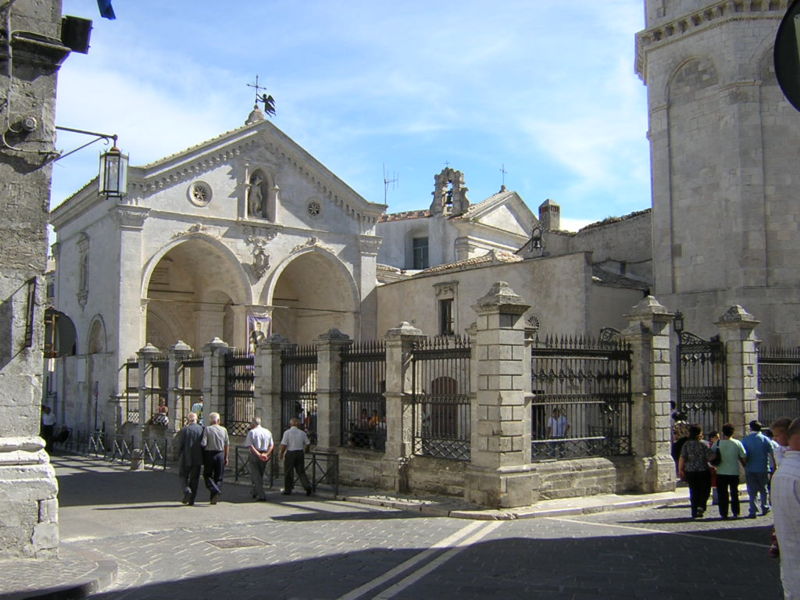
Modern Day Sancturary of St. Michael, the Archangel (Wikimedia Commons)

As these Normans appeared in transit, soon they began to interest the Lombard-led populations.  Several theories have been put forward by Norman chroniclers - Amatus of Montecassino, William of Apulia, and Leone Marsicanus (all in the eleventh and twelfth centuries).  Another theory comes from Radulfus Glaber in his earlier work, ca. 1030 (right after the events themselves occurred).

The earliest reported date for the arrival of Norman knights (engaged in combat) in southern Italy is 999.  In that year, according to several sources, Norman pilgrims returning from Jerusalem by way of Apulia stopped at Salerno, where they met with Prince Guaimar III, during which the city and its environs were attacked by Saracens demanding an annual tribute.  While Guaimar began to collect the tribute, the Normans upbraided him and his Lombard subjects for lack of bravery, and they assaulted the Saracen besiegers.  The Saracens fled, much booty was taken, and a Guaimar pleaded with the Normans to stay.  They refused but promised to show their riches to their compatriots in Normandy and to tell them of possible rewards for (mercenary) military service in Salerno. This account of the arrival of the Normans is sometimes called the Salerno tradition. This was first recorded by Amatus of Montecassino in his “Ystoire de li Normant” between 1071 and 1086, then was borrowed from Amatus by Peter the Deacon for his continuation of the “Chronicon Monasterii Casinensis” of Leo of Ostia, written in the early 12th century.  It is also mentioned by Orderic Vitalis in his "Historia Ecclesiastica".

William of Apulia had an alternative explanation from the years 1015-1016 in Gesta Roberti Wiscardi, dated 1088–1110. He does not mention Salerno in his work, though like Amatus he said that the first Normans to come to Italy were pilgrims. In his version, Norman pilgrims to Gargano encountered Melus, a member of the Lombard aristocracy of Apulia (in Bari) who was rebelling against the Byzantines. These Normans recognized the wealth of the region and the opportunities it offered for mercenaries.

Marsicanus, in the original version of his chronicle of Montecassino gives a briefer explanation that differs somewhat. He described the original revolt of Melus (ca. 1009) and then how he took refuge in Capua where he encountered forty Norman "in flight from the anger of their lord, the Count of Normandy" and persuades them to take part in his proposed invasion. Leone listed the leaders of the Normans as Gilbert Botericus, Rodulf of Tosny, Osmund, Rifinus and Stigand. In the later revision of the chronicle (by Leone or someone else), Amatus’ account is inserted almost verbatim while the list of the Norman leaders is omitted.  Amatus had in his account continued and described how the Count of Normandy had exiled a man called Gilbert Buatère for killing an individual called William, how Gilbert and his four brothers (Rudolf, Osmund, Rainulf and Asclettin) came to Italy and at Capua met Melus joining him in a new uprising. There are a variety of problems with this account especially the dates wherein Amatus appears to contract events that occurred over 20-30 years to imply they occurred in rapid succession. The latter two series of events are referred to as the Gargano traditiion.

The common elements in these accounts are: 1) Normans as pilgrims, 2) the role of political exiles, 3) the naming of Gilbert Buatère and 4) Norman involvement in Melus' second rebellion. Radulf's  version of the Normans’ arrival in "Radulfus Glaber Opera", edited by J.France, N. Bulst and P. Reynolds, Oxford Medieval Texts, Oxford, 1989, pages 96-101, refers to a man called Rodulf who had angered the count of Normandy, correctly named as Richard II (996-1026). Rodulf went with some companions to Rome where it was Pope Benedict VIII (1012-24) who recruited them for an attack on Apulia. Glaber’s suggestion that the pope was the instigator of or at least party to, the attack on Apulia in 1017 is supported by a contemporary French chronicler Adehemar of Chabannes: "Chronicon", edited by J. Chavanon, Paris, 1897, pages 178. Glaber also noted that news of their initial victories led to many other Normans leaving France and coming south. Certainly relations between the papacy and the patriarchate of Constantinople were poor in the 1010s as the papacy had been trying to reassert its authority, largely unsuccessfully, over the bishoprics of Byzantine Italy since the mid-tenth century.

It is possible that these stories are just the two or three tales that survived the times. They may include and be conflated with other stories known then but forgotten now. What we can ascertain is the following:

  1. The events of 999-1000 in Salerno of the Normans against the Saracens need not be dismissed as legend nor does it have to be related to the second rebellion of Melus in 1016-17. Moreover, this account does not invalidate other versions of the Normans’ arrival.
  2. William of Apulia's version of events should be seen as separate from the role of the Norman pilgrims at Salerno. There was a longstanding link between Normandy and the shrine at  Gargano. The presence of Melus at Gargano is likely. 
  3. Norman mercenaries were already in Italy in the early years of the eleventh century. They had been recruited by the abbots of Montecassino and Saint Vincent of Volturno around 1010. Amatus decribes how after the early battles in Apulia in 1017 more Normans "from Salerno" joined Melus’ army suggesting they were already there.
  4. Even the participation of Normans in Melus' first rebellion should not be ruled out. According to a document included in Finium agri Troiani descriptio faeta a Basilio Boiano Prol Ospdthario Catapano Italiae, a. 1019, XVIII, [in:] Syllabus Graecorum Membranarum, ed. F. Trinchera, Neapol 1865, p. 18 (Syllabus), the Byzantine general Basil Boioannes employed another group of Franks (the Byzantines always referred to Normans as Franks irrespective of their true ethnicity) and set them in city of Troia's fortress in the year 1019. What is especially interesting is that, these mercenaries must have lived in Italy for some time before they pledged allegiance to Basil, having served the counts of Ariano (ton areianiton kometon). These two events show that the Franks/Normans earned the reputation of superior soldiers very quickly and that gave them a
    This is the Byzantine Tower in Biccari, several kilometers from Troia. There was a similar structure in Troia built by Boiannes ca. 1017 as part of a network of towers and fortifications extending from northern Apulia to the Adriatic Sea. (Commune di Biccari Website)

    chance to serve under the Byzantine army. The contingent of mercenaries from Troia proved not only to be useful but also faithful. This is shown in another document concerning the same Franks/Normans, issued in 1024, by the same Basil (See Syllabus a. 1024, XX, p. 21), where the aforementioned soldiers served for considerable period of time (as mercenaries) and some of them might have been promoted.
      
  5. The involvement by Pope Benedict VIII with Norman mercenaries in Melus’ rebellion is feasible given growing problems between Rome and Constantinople.  
  6. Glaber also suggested that Landulf V, prince of Benevento was involved, while Amatus and Leone Marsicanus agree that Melus gathered his forces in Capua, presumably with the concurrence of its princes, the two cousins Pandulf II and Pandulf IV. Both Capua and Benevento, which were temporarily united between 1008 and 1014 has ambitions to recover land their predecessors had held in northern Apulia, so their involvement cannot be surprising.
So by 1015, there were a group of Normans living in southern Italy primarily and employed as mercenaries. They appeared to be in service with the various Lombard princes, the Byzantine army and the Roman church. It is likely that various groups of Normans (sometimes including non-Normans but all lumped together as "Franks") would be on opposite sides of service and they did not align with each other or any political or religious philosophy. But that would be about to change in the next decades.

What factors led to the emigration from Normandy to southern Italy?

The first factor that encouraged many contacts between France and Italy during the last quarter of the tenth and the first quarter of the eleventh century was pilgrimage.  Italy was the crossing point of every major pilgrimage route leading to the Holy Land. Normans became familiar with southern Italy, its politics, its culture and its opportunity for advancement.

The next contributing factor to the Norman migration to the south is the over-population of Normandy, but in the sense of “inheritance”.  The best example of this period is the sons of Tancred de Hauteville, whose reasons for venturing to Italy are suggested by Amatus of Montecassino, Geoffrey Malaterra and Orderic Vitalis. According to Amatus “these people [the Normans] had increased to such a number that the fields and orchards were not sufficient for producing the necessities of life for so many” (Amatus, I. 1.), while Malaterra adds that “the sons of Tancred [Hauteville] noticed that whenever their aging neighbors passed away, their heirs would fight amongst themselves for their inheritance resulting in the division of the patrimony – which had been intended to fall to the lot of a single heir – into portions that were too small. [...] Ultimately, … they came to Apulia, a province of Italy.”(Malaterra, 1. 5) Orderic Vitalis noted this through the last “speech” he put into the mouth of Robert Guiscard on his deathbed in July 1085: “We were born of poor and humble parents and left the barren (sterile) country of the Cotentin and homes which could not support us to travel to Rome.” (Orderic Vitalis, VII, p. 32) These accounts underline the fact that the division of the family patrimony was a serious issue in eleventh century Normandy. Inheritance dashed the aspirations of many younger sons for acquiring a piece of land for themselves. The type of “joint tenure” estate, where the younger sons were given a share of the patrimony under the control of their elder brother, which would satisfy the younger members of a family and discourage emigration became standard only in the late eleventh century.  (See E. Tabuteau, Transfers of Property in Eleventh-century Norman law, Chapel Hill, London, 1988, Cahen, La Regime Feodal, pp. 88-9, and Loud, “How Norman was the Norman Conquest of Southern Italy?”, p. 18) 

Next, political factors played an important role in the decision to leave for Italy. Many who did so were exiles, victims of ducal wrath due to their military or political opposition to him, although some were later pardoned by the duke and reinstated. Exile was a common tool of punishment used by the Richard II, known as the “Ullac” (the duke’s right to exile has Scandinavian origin – ullac - and it is first documented in the 1050s: Haskins, Norman Institutions, pp. 27-30; Bates, Normandy Before 1066, pp. 166-67; E. Van Houts, “L’Exil Dans l’Espace Anglo-Normand”, La Normandie et l’Angleterre au Moyen Age, ed. P.Bouet, V.Gazeau, CRAHM, Caen, 2001, pp. 117-27), against uncooperative members of the nobility, in which someone of note would have aroused the interest of the Duke himself.  But the driving force behind the expansion of the 1020s-50s to Italy was the political and social disturbances in Normandy itself and many parts of northern France after the break-down of Robert II’s regime in 1034, and especially during William II’s minority. (See D.C. Douglas, William the Conqueror, The Norman Impact upon England, (2nd ed.), Yale University Press, London, 1999, pp. 31-80; Bates, Normandy Before 1066, pp. 46-93)  

Other Normans were escaping the bitter conflicts between aristocratic families, during the crucial decades for the rise of aristocratic power (1035-55).  These years appear in great contrast to the period of relative stability and peace of the late tenth and early eleventh centuries in Normandy, a situation which had attracted political exiles from other parts of France actually, e.g. Anjou and Brittany, who would become leading members of the Norman aristocracy. The dramatic phase of Norman expansion began when the same type of territorial fragmentation and reorganization of family structures became pronounced within Normandy itself. (See Bates, Normandy Before 1066, p. 244.) 


Saturday, July 6, 2024

The Murder of Benjamin F. Yost, Tuesday July 6, 1875

 "Character!  Character!  What can I say of this despicable wretch, this curse let loose from hell, a confessed murderer, a participant in the most fearful of crimes."

--Lin Bartholomew, attorney, dramatically impeaching a witness (James Kerrigan of Newkirk) who had turned state's evidence against his client in the Molly Maguires’ trial - Commonwealth v James Carroll, James Roarity, James Boyle, Hugh McGeehan, and Thomas Duffy - conducted in Schuylkill County, Pennsylvania in the 1876. [Shenandoah Herald, July 24, 1876]

Background

During the year 1874 and into 1875, the aforementioned James Kerrigan was in the habit of carousing frequently with Thomas Duffy of Tamaqua, PA. [Details about the people and trials from The Molly Maguires : The origin, growth, and character of the organization by   Dewees, F. P. (Francis Percival), Publication date: 1877, Publisher: Philadelphia : J.B. Lippincott] Being Irish, both belonged to the Ancient Order of Hibernians (AOH) and both were hard drinkers. According to some Duffy was a loud and quarrelsome drunk. Kerrigan was himself described as noisy, reckless, ready for anything. They had both been arrested by the Tamaqua police, and locked up on several occasions.

James Kerrigan

One of the two night-shift policemen in Tamaqua was Benjamin F. Yost, a Pennsylvania German. In making arrests, Kerrigan and Duffy had been harshly treated, and on one occasion, during the fall of 1874, Yost beat Duffy severely on the head with his nightstick.

Benjamin F. Yost

Duffy desired revenge. He brought a prosecution against Yost for assault and battery; this case was, however, settled on unknown terms. But his animosity towards Yost did not end, and he determined to kill him. He proposed this to Kerrigan, who agreed, since he had his own grievances to avenge. 

Thomas Duffy

Kerrigan was at this time the nominal body-master of the Tamaqua AOH Division, but the real head was James Carroll, who kept the Union House, a tavern on East Broad Street and sort of AOH hangout. Duffy and Kerrigan met at Carroll's with James Roarity of nearby Coaldale and head of the AOH there. Later, Roarity mentioned this nascent plot to Alex Campbell a liquor-dealer and tavern owner in Storm Hill (Lansford) and previous owner of Carroll’s Union House. Coincidentally, at this time in the neighborhoods of Storm Hill and Summit Hill, it had also determined that another murder was being discussed. - that of John P. Jones, a mine superintendent for the Lehigh and Wilkes-Barre Coal Company (LWC). Thus, the idea of an exchange of killings at once suggested itself. Men from Summit Hill in Carbon County would kill Yost and men from Schuylkill County would kill Jones. 

Site of the Union House Tavern, 132 E. Broad Street, Tamaqua

At this time and certainly after the murder and trial, the AOH was synonymous with was to become known as the "Molly Maguires". A private undercover operation headed in part by James “McKenna” McParlan of Pinkerton Detectives and instituted by Franklin Gowen, President of the Philadelphia and Reading Railroad was several years along at this time. But it is crucial to note that all of this Yost murder planning took place without knowledge of McParlan or John Kehoe the alleged Molly Maguire kingpin.

The actual killing occurred in the early morning of July 6, 1875 when Hugh McGeehan and James Boyle (both of the Summit Hill area) shot Yost at the corner of Broad and Lehigh Streets in Tamaqua. Kerrigan accompanied the actual killers to the site and then led then away.

The murder remained “unsolved” until Kerrigan later was arrested and confessed to the taking part in the Jone's killing later in September 1875.  McParlan, however, became aware of the transaction in the weeks after the Yost murder occurred (when he was sent by his employer (still undercover) to Tamaqua to investigate) and reported his findings. But the decision was made by his employer to not reveal all facts to the authorities to protect its undercover investigation. Moreover, although the record is unclear, McParlan learned of the Jones plot and, half-heartedly at best, warned Jones’ employers; in retrospect, his and his employers' lack of real action likely caused Jones to lose his life.

The Murder of Benjamin F. Yost

Planning

The planning of the murder took place early in 1975 at Carroll's Tavern. Carroll, the de facto head of the AOH Division in Tamaqua was made aware of Duffy and Kerrigan's intent to murder Yost.  Duffy happened to meet James Roarity, the head of Coaldale AOH, at Carroll's. He spoke to Roarity of the murder and Roarity consented (for money), promising that if he did not do it himself, he would send over others who would.

Roarity, after his talk with Duffy, mentioned that they (Duffy and Kerrigan with Carroll's apparent acquiescence) had in contemplation the murder of Yost, and the request made that he should do it, to Alex Campbell (a prominent member of the AOH). It so happened that at this time others in Storm Hill and Summit Hill had also contemplated a murder, the intended victim being John P. Jones, a boss at LWC, who had black-listed several Summit Hiller's (William Mulhall and Hugh McGeehan). An agreement was then made with Campbell. Men were to be furnished from Summit Hill to kill Yost in consideration of Carroll and Kerrigan sending men from Schuylkill County to kill Jones. Mulhall and McGeehan, as parties especially interested, were selected on the part of Summit Hill. Yost was to be killed first. 

The Murder

The Fourth of July, 1875, fell on a Sunday. July 5 was therefore the national holiday. Roarity had come  to Tamaqua, and, about eleven o'clock in the morning, met Kerrigan at Carroll's. Roarity and Kerrigan walked to Storm Hill, and they would come back together later. Roarity and Kerrigan went at once to Campbell's. Inquiry was made for Mulhall and McGeehan, but Campbell said he had not seen them. Roarity found them and reported to Campbell and Kerrigan that they had agreed to go to Tamaqua that night for the killing, and that he would guide them over. Roarity's pistol, had already been sent to Carroll's bar. The point for the assassination of Yost had been selected by Carroll, Duffy, and Kerrigan - the corner at Broad and Lehigh at the west end of the town. 

Location of Yost Murder (July 6, 1875) at Lamp post Broad and Lehigh Sts, in Tamaqua

Roarity then bowed out; his wife had become ill. Then after Kerrigan had left Storm Hill, Campbell and McGeehan, concluded that Mulhall, as a married man with a family, was better left at home, and Jame Boyle, who was available, was asked to go instead, and consented.

After arrival at the Union House, the conspirators wandered about in the kitchen and the barroom, and Kerrigan in different parts of town. The others only went out once before they left. In order to fully appreciate the plan in view, Duffy walked with McGeehan and Boyle up to the chosen location. McGeehan would use the Roarity pistol, and Boyle would have a small single-shot pistol belonging to Carroll. In a bit of irony Kerrigan during the evening met Yost and had a drink with another policeman.

Kerrigan went home to Newkirk and would arrange to meet afterwards. Duffy led McGeehan and Boyle up the back to the (Odd Fellows) cemetery, there to leave them and return to Carroll's bar, as an alibi. Kerrigan met the two at the cemetery and led them to the street-lamp and placed them under large trees nearby where they waited over an hour. Yost and the other policeman (Barney McCarron) came up the street, but, instead of putting out the light at once, as had been expected, they first went into Yost's house to eat. 

The two policemen came out of the house, and Yost proceeded to the lamp post and mounted the ladder, McCarron remaining a distance away across the street. At this moment McGeehan and Boyle stepped forward and shot Yost.  Boyle missed his mark, but McGeehan's pistol inflicted a fatal wound in Yost's right side. Yost staggered from the ladder, exclaiming, "Oh! my God! I am shot! my wife!

The murderers, led by Kerrigan, fled. The other policeman ran after them, firing two shots, which, McGeehan returned.  The assailants scurried along the main road to the west and turned towards the Sharp Mountain. Kerrigan took them through unfrequented paths, then again turning into the town they passed through alleys and back streets to the eastern limits of the borough. The had met no one. Kerrigan continued with them until they were certain of their road back, and then returned to his own home unnoticed. 

Dr. Solliday arrived, examined the wound, and confirmed that Yost was mortally wounded. Death did not, however, occur until ten o'clock the next morning. In the meantime Yost conversed with Dr. Solliday, with Squire Lebo, Conrad F. Shindel, and with Daniel F. Shepp, a brother-in-law of Mrs. Yost. Neither policeman could confirm the identity of the shooters nor did they implicate Kerrigan or Duffy only confirming there were two assailants, not seeing Kerrigan.

McParlan in Tamaqua to Snoop Around

After Yost died, an inquest was held without result. Months passed and no arrests were made. The public would settle into the belief that it was but another murder open and defiant but impossible of detection. 

Nevertheless, Michael Beard, Daniel Shepp, and some others in Tamaqua, could not rid themselves of suspicion. Yost had not, to their knowledge, except Kerrigan and Duffy  (cleared by testimony of Mrs. Carroll and the dying declaration of Yost), an enemy in the world, and a murder entirely motiveless was beyond their comprehension. It was determined by Daniel Shepp and Michael Beard to employ the Pinkerton Agency, if necessary, at their own expense. Pinkerton representatives did not disclose to them the details of their ongoing undercover operation, but McParlan received instructions on July 14, 1875, to investigate and report about Yost.  Mc Parlan, as McKenna, made his appearance in Tamaqua, the scene of action, and conducted his investigation. He knew the Union House to be an AOH hangout, and, going there, for the first time formed the acquaintance of James Carroll. Carroll had heard of  McParlan (as McKenna) and one of the trusted AOH leaders of the Mahanoy Valley lodges and thus treated him cordially.

He used the pretext of AOH business to re-connect with Alex Campbell to whom he was somewhat acquainted, and by July 25, had learned that Yost's murder had been performed by unnamed members of the Summit Hill lodge. McParlan now temporarily based himself in Tamaqua, calling again at Carroll's bar, and learned about the murder weapons, the two pistols, that one was  Roarity's  and a small one was Carroll's. The conspirators were identified as Duffy, Kerrigan, Roarity, and Carroll. He did not, however, give the names of those who actually committed the crime. McKenna who had been stopping at the Columbia  House (at the Five Points) in Tamaqua now concluded to make Carroll's his local hangout. He also began calling, romantically, on Kerrigan's sister-in-law Mary Ann Higgins, all to avoid suspicion of all his time spent now in Tamaqua,

But the Yost murder remained “unsolved” until Kerrigan confessed to it and another murder in 1876.  McParlan, however, knew of the transaction in the weeks after the Yost murder occurred and reported his findings. But the decision was made by his employer to not reveal all these facts to the authorities to protect its undercover investigation. Moreover, by August McParlan learned that the Yost killing was a trade for the imminent planned killing of John P. Jones of Lansford.  Although McParlan was able to warn Jones, in retrospect, his and their lack of real action caused Jones to lose his life on September 3. The actual perpetrators of that crime were caught in the normal course of policing. It was that first Molly Maguire show trial that was tried without full undercover disclosure.

During the late stages of the Jones trial Kerrigan broke. Locked in solitary confinement, the Tamaquan, became apprehensive and decided to save himself and turned informer. The confession which contained the principal outlines of McParlan’s prior reports of the plans to kill Jones and their relation to Yost's murder in Tamaqua. Now the State/Local authorities could bring that case to trial as they immediately arrested the men implicated by Kerrigan, but they still did not know the presence of undercover agent, McParlan and how he implicated the same men. However, these arrests created a flurry of rumors. Fearing that others involved would leave the area, Coal and Iron Police (acting as the State) rounded up additional men (implicated by McParlan) and beyond Kerrigan's knowledge. Since Kerrigan did not know the men arrested by the second posse, the Molly Maguires could only suspect the existence of a second informer. Shortly thereafter, McParlan disappeared from Schuylkill County until the Yost murder trial.

The Trial

Following the conviction and sentencing of the first two Molly Maguires in Mauch Chunk, attention shifted to Pottsville, where another series of showcase trials was staged in the summer of 1876.The first of these highly publicized proceedings began on May 4, 1876 with James Carroll, Thomas Duffy, James Roarity, Hugh McGehan, and James Boyle facing trial for the murder of Benjamin Yost. James McParlan (in his Pinkerton Reports) and Kerrigan (in his confession) had both linked the Yost killing to the Jones case as quid pro quo to each other.

In the afternoon of Thursday, May 4, 1876, District Attorney Kaercher announced to the court, then in session at Pottsville, that the Commonwealth was ready to proceed in the trial of James Carroll, James Roarity, James Boyle, Hugh McGeehan, and Thomas Duffy, charged with the murder of policeman Benjamin F. Yost on the night of the July 5 and 6, 1875, at Tamaqua. The case was to be tried before a full bench, with Judge Cyrus L, Pershing presiding, with Judges David B. Green and Thomas H. Walker, and Associate Judges Kline and Seitzinger. 

When the case was called the Commonwealth was represented by District Attorney George R. Kaercher, joined with attorneys Hughes, Albright, and Guy E. Farquhar. Attorneys Ryon, Bartholomew, and Kalbfus appeared for the defense. The defendants had agreed to be tried together. The defense was calculating fully on breaking down the testimony of the informer, Kerrigan, and thus, were hopeful.

As in the Jones trials, the jurors were primarily of German extraction. One juror, Levi Stein, admitted, "I don't understand much English"; another, William Becker, asked to be questioned "in Dutch (Deutsch or German) as I am light on English ... I would not understand the witnesses." Both men were accepted as jurors. No juror was Irish. [See Albright, The Great Mollie Maguire Trials, v and Broehl, The Molly Maguires, 296]

After the jury was chosen, on Saturday morning the case was opened by Kaercher. He confirmed that the testimony of James Kerrigan, the accomplice, would be offered, and that a man who for years had lived in the county, associating periodically with these men, and who had learned the history of their crimes, known to them as James McKenna, would also be put upon the witness stand. His name was James McParlan, and he was a detective employed by the Pinkerton Agency, in the employ of the Philadelphia and Reading Railroad. This was the first public acknowledgment of an undercover plant infiltrating the so-called secret society of Molly Maguires. (It is useful to remember that neither Kerrigan or McParlan testified in the Doyle or Kelly trials. So this would be their coming out party.) [See McParlan's testimony in the Yost trial, Among the Assassins!, 16—17; and, for a fuller account, see his testimony in K.C.K, 92-98. Cf. Pinkerton, The Molly Maguires and the Detectives, 497-508; Dewees, The Molly Maguires, 252-74; Broehl, The Molly Maguires, chapter 11.]

During the Kaercher’s opening speech, Franklin Gowen, the President of the Philadelphia and Reading and himself an attorney, entered the court and took his seat at the counsel-table of the prosecution. Benjamin Franklin, head of the Pinkerton Agency at Philadelphia, entered at the same time, and took his seat close behind the bar. 

The LWC, which had openly shown their position in the Doyle and Kelly prosecutions made no secret of the fact that they had also engaged the private counsel in the present prosecution. The presence of Gowen indicated that not only was his legal ability (he had been the Schuylkill County District Attorney in 1862-1864) to be used on behalf of the Commonwealth, but also that the Railroad, with its vast resources and power, was openly engaged in the contest with the "Molly Maguires." 

In another bit of showmanship, the drama was heightened when, toward the end of Kaercher's opening, ten more “Molly Maguire” prisoners were led past the courthouse in chains to Schuylkill County prison, having just been arrested. They included John Kehoe, the AOH delegate for Schuylkill County and the alleged ringleader. "The news of the latest 'catch' spread through the town like wildfire, gathering in a short time an immense concourse of excited citizens all anxious to learn the details … Poor fools! They imagined themselves sharp and capable of committing any deviltry without being followed—not to mention captured by that justice which sleeps, but never dies." [Shenandoah Herald, May 8, 1876] Now at last, the Herald exulted, the Mollys were about to be "swept from the face of the earth."

Late on Saturday, May 6, just after Kaercher's opening speech, James McParlan entered the Pottsville courtroom for the first time, accompanied by Captain Linden (both a Pinkerton and railroad employee) and two Pinkerton bodyguards. On the first day of his testimony, McParlan described his relation to the Yost case, how he had heard firsthand confessions from Carroll, Roarity, and Kerrigan, and how Duffy was the mastermind behind the whole affair. This evidence, on its own, might have convicted the defendants, but on Monday the prosecution extended its case into a general indictment of the AOH, which McParlan (in retrospect conflated with and) called the "Molly Maguires".

This constant linking of the AOH and the Molly Maguires was an important prosecution strategy, as it attributed the crimes to a large, well-organized society, supporting Gowen’s claims that it was the basis of a major conspiracy. Remarkably, by McParlan’s third day on the stand, even the defense had accepted this admission that the organizations were the same. At one point Bartholomew asked McParlan: “As I understand from your testimony, you were initiated into the Ancient Order of Hibernians or Mollie Maguires, on the 14th day of April, 1874?[The Daily Miners’ Journal, May 9, 1876] McParlan thus offered minute details of the inner workings of a conspiracy. Much of his testimony was corroborated by the informer Jimmy Kerrigan. [MJ, May 5 to May 18, 1876; Among the Assassins!]

With the prosecution poised for a major conviction, the trial was suddenly disrupted on May 18, when the aforementioned Levi Stein, one of the German-speaking jurors fell ill. The case was suspended, and when Stein died on May 25, the judge dismissed the jury and declared a mistrial. 

The setback for the prosecution was temporary.  There was little doubt in anybody's mind that the testimony offered by McParlan and Kerrigan had doomed the five defendants. All that was needed was to arrange a new trial. In the meantime, the defendants in the Yost case were remanded in custody. 

That new trial took place between July 6 and 22 and resulted in the expected guilty verdict for four of the five defendants. Duffy requested and was granted a separate trial, which was held in September.  He was likewise convicted.


Friday, May 24, 2024

PART 1 - One Son's Father - Retrospective of My Father's Service in World War 1

This is a personal history of my father's time spent in World War 1. My father was an Italian who served in the Brigata Macerata from 1915 until 1919. He was in the 121st Infantry Regiment (Reggimento di Fanteria). He fought in the Isonzo (1915-1916), the White War (1916-1918), the Piave (1918) and in the ultimate Battle of Vittorio Veneto (1918) against the army of the Austro-Hungarian Empire. Americans (and indeed the British, French, and others) probably do not know this war in Italy so much. Well, here is a little history lesson (in several parts) to remedy that ignorance. The story begins in Teramo Province in Abruzzo. The story starts out slowly with typical rural Italian life

Clouds of War

The Old Life

On June 28, 1914, the assassination of Austro-Hungarian Crown Prince, Archduke Franz Ferdinand in Sarajevo was to affect the lives of millions of young men throughout the world. One of those young men was my father. He was a 19 year old son of a contadino (farmer who either owned some land or worked for others not owning the land, like a sharecropper). His mother had died in approximately 1900, leaving my grandfather to fend for three young children – my uncle age 7, my father age 5, and my aunt, age 2. 

By 1909 my grandfather had remarried and had two additional sons born in 1909 and in 1913. Later two other children would be born – a daughter in 1916 and a final son in 1919 - to complete the family.

My father would have likely been working with his father helping him farm and take care of this family. The story passed down is that my grandfather was a type of sharecropper, a system known as the mezzadria. Large landowners (padroni) would divide their land into sections and allow other families to live on it and grow crops. Half (or some other percentage) of the produce (or the revenue from the sales of such) would go to the landowner. My family by the accounts of my aunt did well enough. A typical farmer in Abruzzo would have produced all the food needed to feed his family. Four or five people could survive on the produce of one ettaro (hectare - about two and a half acres) of land. The family took care of everything, like a small family-run farm. Generally, everyone knew how to do everything, but everyone had their specific tasks. Their plot would have grown a large variety of vegetables the same as are seen in farmers’ markets today, including carrots, potatoes, beets, garlic, onions, radishes, turnips, artichokes, tomatoes, eggplant, asparagus, fennel, chard, spinach, broccoli, cabbages, cauliflower, peppers, beans, lentils, chickpeas, zucchini and other types of squash, and peppers. Years later in America my father would grow many of the same vegetables in his backyard plot. Whereas our “American” neighbors would have a yard of flowers and grass, our backyard was filled with vegetables (every square foot).  In addition to the vegetables, wheat and corn was probably grown.  Then they would have had fruit trees: apples, pears, apricots, peaches, figs. Every family had its own livestock - chickens, pigs, rabbits, sheep and cows (for both milk and meat). Extra eggs, vegetables and fruit would have been sold at the markets in old Atri or in new and growing Pineto. 

Sharecropping spread from the late Middle Ages in various parts of Europe, as a productive relationship framed by the feudal system. In Lombard feudal society it was the "manente": an agricultural worker who resided on land that he did not own, which he cultivated and whose profits he shared with the owner. [See Treccani.it - ​​Online encyclopedias , Istituto dell'Enciclopedia Italiana, 15 March 2011.] Since then, November 11 was the expiration date of all agricultural contracts, including mezzadria contracts, when all the activities related to the previous ended & to which a new year would begin. "Fare San Martino" literally meant moving, if the sharecropping contract was not renewed; vice versa, if it was. This became a feast day; people began to sample the new wine, oil & chestnuts etc.

Every farming family also had its vines to grow Montepulciano or Trebbiano grapes for making wine and olive trees to produce oil. Wheat, corn and olives were brought to local water mills for grinding. Chestnuts were also used to make flour, especially important for farms that were not suitable for growing grain. Much of the grain had to be dried and stored on the upper floor of the houses and barns to keep the animals fed during the winter months.

Life Changing Events

It would seem that the family would, in rural Abruzzo, have had little reason to much notice world events ongoing in 1914, with one exception.  The older brother was already serving in the Italian Army.
 
On July 28, a month after the assassination, Austria-Hungary declared war on Serbia.  This set in motion a series of war declarations driven by alliances between major European countries:
  •  Austria-Hungary had sought German (its ally) support for a war against Serbia in case of Russian “militarism”. Russia had close relations - almost as a protector - but no formal treaty with Serbia (both countries tied together by their large Slavic populations. Germany gave assurances of support. (July 5) This was weeks before the Austrian declaration of war;
  •  Germany declared war against Russia (August 1);
  •  Italy, a member of the Triple Alliance (with Austria and Germany) declares neutrality (August 3), claimed that its pact only applies to defensive actions. Italy’s actions seemed (to its citizens) that war would be avoided by Italy; 
  •  France mobilized (August 1) in response to the declaration of war on Russia.  France had a military alliance with Russia:
  •  Germany declared war on France. (August 3);
  •  Germany invaded France through neutral Belgium. (August 4) In response the United Kingdom declared war on Germany (August 3) as a violation of the Treaty of London (1839) – guaranteeing Belgian neutrality;
  •  Austria declared war on Russia. (August 6);
  •  Serbia declared war on Germany. (August 6);
  •  France declared war on Austria. (August 11);
  •  the United Kingdom declared war on Austria. (August 12)
Despite war now raging in Belgium and France in the west of Europe and Russia in the east and Serbia in the southeast, everyday Italians seemed reasonably assured that war was not going to directly affect them. However, the Italian state was taking steps to defend against war. Luigi Cadorna, the Italian chief of staff, began to move troops to the Austrian border on August 21. It appears, however, that no formal mobilization order was issued. 

By September and October, an Italian interventionist (pro-war) movement was underway fueled by “Italia irredentia”. The elected government of Prime Minister Salandra (the majority of socialists and Giolittiani (followers of opposition party head Giolotti) were still neutralist, as well as a large share of Catholics) began to secretly probe which side would grant the best reward for Italy's entrance in the war and to fulfill Italy’s “Irredentia” claims. The government does not do anything but let the pro-war movement happen and take note of the situation. “Italia Irredentia” was keen to annex Italian-speaking portions of the Austro-Hungarian Empire such as Trentino (the South Tyrol), Trieste and Dalmatia (Istria), on the east coast of the Adriatic.

Diagram from the London Telegraph May 25, 1915 showing the areas of Trentino and Trieste Istria significant to Italy’s entry into the war. Most knew about Italy's general intentions despite the specific negotiations being secret.

Farmers and rural citizens such as my family could probably not have cared less about this, but eventually the interventionists succeeded and secret government negotiations ensued with the western allies as well as the Triple Entente, in a version of let’s make a best (for Italy) deal after a new Foreign Minister (Sidney Sonnino) is named in November.

On December 14, 1914, my father registered for the Liste di Leva (Draft) and was given a physical and other tests.  He was put into the 1st category, conscripted soldier, class of 1895, Teramo military district and left on “unlimited leave” (i.e., not inducted at this time). 

Less than a month later, on January 13, 1915, my father was left in provisional “unlimited leave” pending the discharge of brother to the matriculation under the terms of art. 6, of the law December 15, 1907. He was to report for presentations to arms with his class eight days after his brother's discharge. 

The Liste di Leva contain the names of all those young residents in an Italian province who were twenty years old and in phusical condition to go to the military service.   Conscription of all males at the age of eighteen was instituted in Italy in 1862, shortly after Italy became a nation. Every Italian male was and still is required to report to the draft board for a physical exam. Within the recruitment plan of 1907, all able-bodied men were chargeable for call-up in 3 classes between the ages of nineteen and thirty-eight years. The first class spent 2 years on active duty, 6 in the reserve, 4 in the Mobile Militia, and 7 in the Territorial Militia. The 2nd class spent 6 months on active duty, 7 and 1 / 2 years in the reserve, and the same periods in the militia as class one. The 3rd class spent all 19 years in the Territorial Militia, however having received no training.

It is unknown when my Uncle was ultimately (if ever) discharged (or his class 1 or 2) – given the imminent war.  It is also unknown if either brother would have any idea that Italy would soon be at war.  Life went on for the average rural Italian - good and bad. For example, on this same day in January (13th), a violent earthquake shook the Abruzzi, Lazio and Campania, with the main center in Marsica, about 125 km away from where my family lived, Mutignano, which felt the tremors. Over 370 municipalities were damaged and 50 thousand people perished. 

On March 22, my father turned 20 and became eligible for military service under the 1907 law but for his brother’s on-going service.  By this time it is inevitable to the government that Italy will enter the war.  However, the average citizens do not know this.  The government conducted all negotiations in secret. In fact on March 28, an Italian royal decree prohibits the publication of military news until June 30.  Recognizing the seemingly inevitable, Austria established new fortifications around the capital, Vienna, and the forts near Trentino and the Isonzo (Italian border areas) were armed.

On April 26, at a secret meeting held in England, representatives of the Italian government agreed to enter the war in return for financial help and the granting of land currently under the control of Austria-Hungary. This Treaty of London resulted in Britain granting an immediate loan of £50 million and a promise to support Italian territorial demands after the war. The negotiations with the Allies have been long and secret. In political Italy there are only three people in the know: Prime Minister Salandra, Minister of Foreign Affairs Sonnino and King Vittorio Emanuele III. Even the Parliament is kept in the dark. Then on May 3, Italy officially revoked the Triple Alliance.
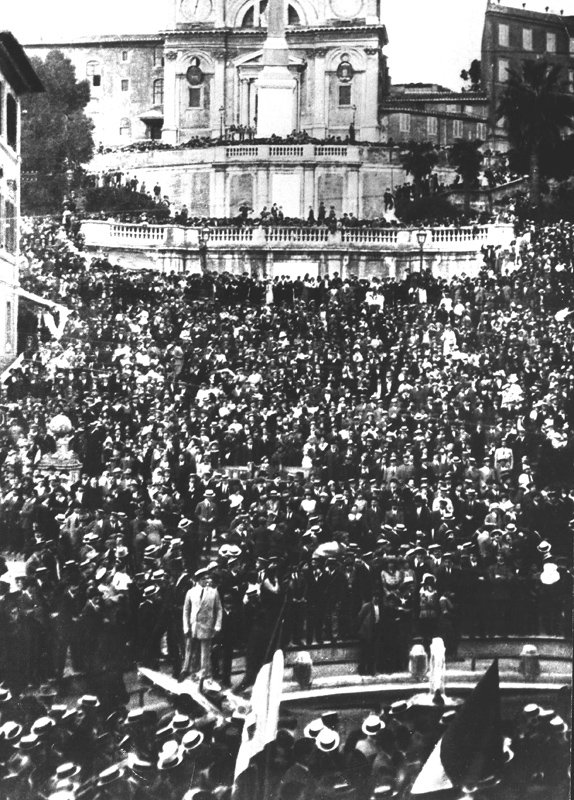
Interventionist demonstration at the Spanish Steps in Rome (May 1915)

Intervention demonstrations in Italy keep increasing in number, size and location - impressive interventionist demonstrations were everywhere. In Rome Giolitti deputies are insulted and beaten up; in other places, as in Milan, there are physical conflicts with the neutralists. On May 13, knowing that the consensus of the elected parties is lacking Salandra presents his office’s resignation of the government to the King, who reserves the right to decide, and which is ultimately rejected on May 16.  These acts appeared to put the government over the top for intervention. Five days later, the Italian Senate unanimously approved the bill granting full war powers to the Government. The news causes the closure of the border between Italy and Austria-Hungary (including rail and telegraph). In Italian speaking Trieste (then in Austria), military law was proclaimed.  This vote is followed by the Parliament, under pressure from the interventionist demonstrations, for approval, with 407 votes in favor, 74 against and 1 abstention, for the bill conferring to the Government the extraordinary war powers. 

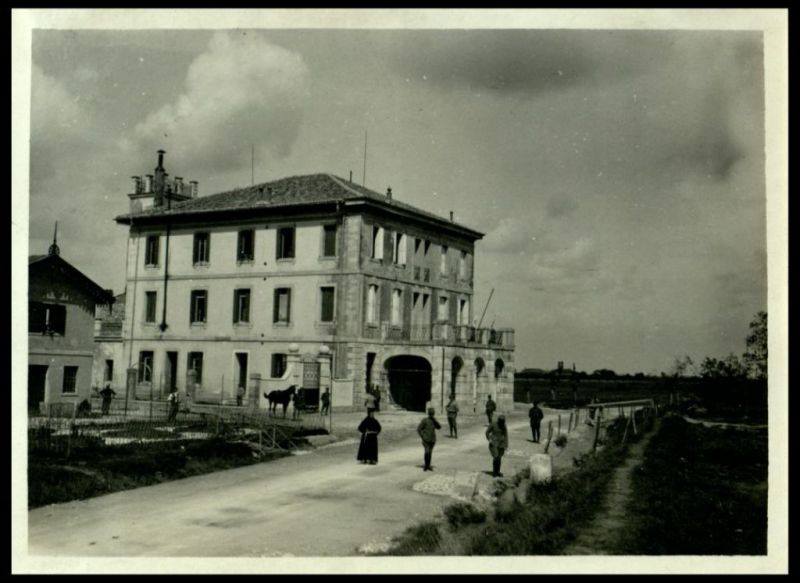
The Customs House at Trivignano Udine on the border with Austria, near the Torre River.

On May 22, Italy instituted a general military mobilization to increase the size of the military - R.D. May 22, 1915 Circular of the G.M., under which the King has decreed the general mobilization of the army and navy and the requisition of equipment. The mobilization was set for the next day.  With this communiqué King Vittorio Emanuele III prepares the country for the conflict.  In the provinces of Sondrio, Brescia, Verona, Vicenza, Belluno, Udine, Venice, Treviso, Padua, Mantua, Ferrara and in those of the Adriatic, a state of war is proclaimed.  On May 23 Italy declares war on Austria-Hungary, although not on the Germany (which will occur until 15 months later, August 28, 1916).
La Stampa, Turin: Headline of May 23, 1915 announcing the General Mobilization (War Declaration Not Yet Announced Until Later that Same Day)

Now my father’s life is about to change.  On June 1 he is called for active duty into the Italian Army, under mobilization by the R.D. May 22, 1915 Circular of the G.M. and arrived in the 14th Infantry Regiment (Pinerolo Brigade). The 14th Regiment is normally stationed in Foggia (Puglia), while the 13th (its brother regiment) is stationed in L’Aquila (Abruzzo). The history of Pinerolo indicates that between May – December this unit was at the front yet my father’s record does not show this. In some regard there would have to have been some basic training going on. It would appear therefore that he underwent several months of infantry training (addestramento di fanteria) with the 14th Regiment (at L'Aquila or Foggia).  Six months later on December 2, Angelo arrived in the War Zone, territory “declared in a state of war assigned to the 121st Infantry Regiment (RF). This unit was located at the front line at the Castelnuovo del Carso Sector.
Part of my father's Italian Military Record, the Ruolo Matricolare which records all the developments in a military career, from promotions to changes in status.

Under Italian conscription, a fraction of those suitable actually served in the army, e.g. in 1911 under 25 per cent of those eligible (each year) for military service were in fact called up. Consequently the active army consisted of regular officers – always in lower numbers than needed – in addition to class 1 recruits. To make situations even worse, the recruits were expected to review in each November, annually. On the other hand real military service was postponed until the subsequent March. Because the difference wasn’t, in reality, filled up with by class 2 soldiers under training, there was simply no army in being throughout the winter season. Even in summer several units had below 10% of their nominal strength.

Difficulties were worsened by a severe lack of non-commissioned officers (NCOs), who were typically drawn from Italy’s tiny literate lower middle class. Moreover, the Italian Army was still affected by the “mopping up” of Italo-Turkish War in Libya in 1911-12. There was a lack of equipment to replace that lost in this prior war.

In spite of this, the army did accomplish significant improvements during the prelude to World War One. By May 1915, General Cadorna, had mobilized 23,039 officers, 852,217 other ranks and 9,163 civilians. Italy joined the war with twelve army corps (constituting four armies) inside Italy, each with 2 active infantry divisions. The First and Fourth Armies were sent to the Trentino Front and the Second and Third Armies to the Isonzo Front.

New Life

Many of the five million Italians who served in the First World War received their basic training before the war, during their compulsory military service. The inadequacy of infantry training in this period had already been highlighted by the war against the Turks for Libya in 1911-12. Italian conscripts trained in simplistic and rigid tactics found themselves facing small, mobile bands of motivated Turkish and Arab forces, which repeatedly inflicted tactical defeats on the Italians. The Italians were pressured into using cautious, hesitant tactics which were ill-suited to their ambitious strategic goals, and their ultimate victory was more due to the weakness of the Ottoman Empire than to Italian military prowess.  Even reform-minded critics such as Captain E. Bottini saw the Libyan war as “comforting proof of the success of our patiently developed educational work”.

In regards to the new troops who would eventually begin to comprise the bulk of the Italian Army as time passed, army authorities relied on a relatively decentralized system. The design and implementation of most training exercises was handled at brigade level or below. In 1915 officers responsible for training were given manuals of doctrine but little advice on how the desired outcomes were to be achieved or what were the best methods for informing and preparing the troops. Not until early 1917 were more specific instructions on how to train regularly issued from Supreme Command or Army.
  
Basic training was already somewhat flawed before 1915, but wartime bought new pressures: time, money, experienced instructors and equipment were all in short supply. Insufficient time was especially critical, since training, like rest and recreation, was rarely a priority for the army authorities in 1915-6. The need to get new men into the lines quickly often overrode other considerations.  Lt-Col. Francesco Rossi, of the 224° regiment (Etna Brigade), reported in June 1916 that:
“The unit is composed almost entirely of the class of 1896 whose hasty instruction (little more than three months) has not been sufficient to ensure an adequate preparation for the campaign, either with regard to technical training or with respect to physical endurance.”
Rossi concluded that after a necessary period of rest, to help overcome minor health problems and fitness-related injuries, his men required a week of intensive tactical training before returning to any kind of active service. Training was not just brief but it was often ineffective in tactical terms, rarely corresponding to the realities of trench warfare. Conscripted into an infantry regiment in August 1914, Gino Frontali described his experiences of basic training:
“We received our first lesson in ‘open order’ and ‘tactics.’ Our lieutenant explained in minute detail the essential rules: be silent, obey signals, always look at the officer in charge, adapt movements to the ground, use shelter in order to offer the smallest possible target, never drop vigilance and observation in order to guard against any surprise.”

This description suggests that trainers acknowledged the need for greater tactical sophistication than close-order drill alone would permit but emphasizing the need to follow the officer closely in all things left infantrymen lost and unable to proceed without leadership – if officers fell during combat, their men had no experience in taking the initiative themselves.

The acute shortage of experienced officers and NCOs who could conduct effective training was another cause of these problems. Alpini Lieutenant Garrone recorded that he was “daunted” by the scale of his task in training his men, and complained that he had been given insufficient guidance and support. Since officer training was itself weak on practical matters, tactical instruction and personnel-management, junior officers' task was an unenviable one.

Along with time and experienced instructors, the Italian army was critically short of equipment. Weapons handling and target practice, among the most fundamental elements of infantry training, were deeply flawed.  Any form of firing practice was difficult given the acute shortages of equipment. In August 1914 the Italian army had at its disposal 750,000 rifles of the 1891 model, supposed to be the standard, and no hand grenades at all. Training was therefore sometimes carried out with just one or two rifles per company, each man taking turns with the weapon. Gino Frontali described the situation in late 1914:

Target practice suffered from a most serious defect. It was done in a great hurry… we fired two rounds (twelve shots each) every week. This exercise was sufficient to familiarize us with the use of the rifle, but not to establish any precision of aim. One saw progress only rarely. Those who [already] shot well, who had a passion for hunting, improved a little after the first lessons. The others, the majority, hit the target only rarely, and no-one seemed concerned about it.”

There are other rememberances of the training camp at Porretta near Modena and almost none of them is positive: "For two months in Modena and for one under the tent in Porretta I learned a few military things and certainly nothing of war" recalls for example Alberto Ghisalberti of the 42nd Infantry, and concludes: "At least we learned to pitch a tent!" Certainly the training that was provided by official cadres left most unprepared at the beginning of the war as training differed greatly from the reality of the front.
A panorama of a portion of the training camp (campo di addestramento) at Porretta (Modena)

The shortage of weapons with which to train also affected machine-gun units and the artillery, some of whom were forced to practice maneuvering their weapons with wooden models. Frontali reported an infantry major's comments in May 1915: “We have no machine guns, they are running courses for machine gunners using wooden guns, and none of the gunners have ever fired a shot using a real weapon.

In May 1915, when its neutrality ended, Italy’s entire stock of machine guns was 618 (including those in use in Libya and not all in working order) compared with 1,500 for Austria-Hungary, 2,000 for France, and 3,000 for Germany when these countries had started to fight some 10 months previously.

The Italian Front Overview

When war came to Italy in May 1915, it opened up a third front for Austria-Hungary – the major front in Russia, the Serbian Front and now in Italy. The Italian Front covered about 600 km from the Swiss border to the Adriatic Sea – covering two areas, the Trentino (and Tyrol) in the west and the Carnia-Karst (Carso) in the east (the Isonzo).  The Austrian Command was unable to face its former ally with more than just a defense force - barely managing to garrison the new front. The Austro-Hungarian Command shortened the front, moving back the defensive lines along a system of trenches, caves and fortified shelters arranged in the previous months. 

The Austro-Hungarian Army was composed of three parts: the joint army ("Imperial and Royal Army" - kaiserlich und königliche Armee or k.u.k.), recruited from all parts of the country), the Imperial Austrian Landwehr and the Royal Hungarian Honvéd. In July 1914 the force included - 36,000 Officers, 414,000 NCOs and troops, 120,000 horses (estimate) and 1,200 artillery pieces.  After war was declared, the force had 3.35 million men (including the first call-up of the reserves and the 1914 recruits).

The Imperial Army had about 115,000 troops in the Isonzo/Carnia Front.  However, the size of that Army kept increasing as the Imperial Army was able to move troops from both the Serbian Front and the Russian front as these areas had turned into an Austrian and Austrian/German advantage with losses by both the Serbs and Russians in late 1914 and early 1915.  The Imperial Army moved its front lines in Italy to easily defensible positions on high ground essentially abandoning the lower valleys and plains (what little there were) of the political borders. There were few fortifications along the Isonzo front before 1914, so a defensive line based on field fortifications, wire and minefields, was hastily 
The Italian Army advances in May 1915 into areas abandoned by the Austrians for defensive positions in the higher mountains (blue) and the Austrian mountain defenses (red)

constructed, in particular around the plateaus of the Bainsizza (at Gorizia) and the Carso.  The Austrians hastily built powerful defenses in the area, using terrain to its advantage and literally blasting strong dugouts, trenches and gun-pits from the rocks. The Imperial Army essentially gave up a small amount of low-lying territory in return for a huge tactical advantage. To defeat the Austrians and drive them from these formidable positions the Italians would need considerable firepower (especially heavy artillery), competent leadership and NCOs, and effective tactics suited to such warfare. Italy had none of these.

The troops deployed in defense of the Tyrol amounted to about 35,000 men; the Tyrolean Standschützen companies were also mobilized.  In support of its ally, the German army also sent some departments, although when Italy entered the War, they did NOT declare war against Germany.  Similarly, the Austrians had built formidable defenses in these mountains as well.  In September 1914, the Austro-Hungarian General Staff commissioned General Franz Rohr to build the Tiroler Widerstands linie (Tyrolean resistance line [linea di resistenza Tirolese]), an uninterrupted entrenched line from Tonale to the Marmolada to be used in the event of a conflict with the Kingdom of Italy. About 20,000 civil workers were employed. Around Trento a new massive fortification was also set up.

The Italians on the other hand were interested in an offensive war in support of Italia irredentia. Cadorna had planned for the Italian army to take up a defensive stance in the Trentino, launching its 
 offensive across the river Isonzo, which snaked down to the Adriatic sea in the east, on two main directions: from the Cadore and from the Carnia.  The main attack fell to the left wing (2nd Army), its goals being Ljubljana and later Vienna, with Trieste as a secondary objective to be reached by the right wing (3rd Army).

Young Soldier - 1915

Arrival at the Front

On December 2, 1915, my father arrived in territory “declared in a state of war, i.e. the war zone, to the 121st Infantry Regiment (RF). The unit was located at the front line at the Castelnuovo del Carso Sector.

One cannot imagine arriving at an area where people are waiting to kill you in battle. The young farm-boy who until some months ago had probably not ventured very far from his home in Abruzzo now ventured into Venezia and Fruili.  The following is an excerpt from a diary by someone probably much like my father who arrived in this same time frame in November 1915.  Domenico Bodon, a private with the Chieti Brigade (124th Infantry Regiment), who arrived behind the front lines at Ruda/Villa Vicentina on November 7, 1915 wrote:

We are very close to the front, all around houses are destroyed.

In a town where the train is forced to stop, there is a huge camp and in the middle, the Italian flag. 11 am.  The village is called Villa Vicentina, the last station as the train can no longer continue, because the enemy lays further on; I'm still on the train and without food since last night. We disembarked and the appeal is made to stay close to it. Nice weather. The cannon thunders continuously. It starts at 11 and a quarter. At one and a half we are facing the enemy on the spot where the shrapnel landed this morning. You can see the holes made without misfortune. Still wanting to eat and I find myself in a field full of mud. After 2 hours of waiting we were ordered to wait.

Oh God! In that mud, where, now traversed by other soldiers, you sank to the whole shoe. Patience! We planted the tent and meanwhile those of us 5, destined for this work, were free, went in search of straw, something to put down our poor bones. In the end everyone got sweaty and then he went to get the bedding getting 4 kilos for each one.

5 o'clock in the evening. We are at the end. Meanwhile, we talk with several companions who tell us the name of the locality is Ruda. The night comes and at 7 pm the ration came: a little pasta and a nice piece of meat, almost raw; but hunger is so great that we had to swallow it to pieces. The thirst began; and where in the night to find the water? A companion showed us the point and then we started splashing in the puddles. We reached the fountain and drank to fullness. And then a mess tin brought it to me under the curtain.

So here we are at night high, prepare the bed, we will say, without lighting matches, all groping. In the meantime, one was preparing, the other waiting, until the last one arrived to close. I was the last one.

In that time I was waiting, a show of the most gruesome presents itself to me. On the Isonzo front, there are always great reflections, but many, that run with their trajectory of long pieces, so that our, under that strong clear, could see the enemy pieces; and then the cannon that was ready fired with a tumult that in the middle of the night was disgusting. Know among other things that we are stationed near a cemetery. At the same time you can also see the shrapnel split in the air and then maybe do damage that I cannot explain now. In short, I was so impressed that I immediately went to bed with the idea that perhaps among those 4 sheets to stay safe.

It is unlikely that my father was thrown immediately into the front. On 14 December, the 121st RF is relieved at the front and goes back to the rear at Campolongo and Armelino, near Ruda. The Regiment remains there until January 2, 1916. So there was no combat in 1915 for my father.

While the Regiment is in the rear, one of the primary roles is to continue to train itself and its new members of the group such as my father. These young men are not yet soldati (soldiers) and know very little of what they are facing.  The 121st Regiment was part of the Macerata Brigade. The Brigade was established on March 1, 1915. The Brigade command and its brother 122nd Regiment were taken from the 12th Infantry Regiment; the 121st Regiment from the 93rd Regiment.

It is not known to which Battalion my father was assigned, either infantryman or special weapons or in a pioneer unit as a “genio” / “zappatori” or engineer/sapper. The Army’s basic unit was the “Regiment”. Each Regiment at full strength consisted of three “Battalions” (of 1000 men each, further divided into four “Companies” of 250 men.  Each Battalion had three rifle companies and one special weapons company generally with a machine gun squadron, a mortar squadron and a pioneer platoon, tasked with construction duties.

“Macellata” - Brief History of the Macerata Brigade in 1915 

The Macerata Brigade by the time my father reported had become known as the “Macellata” Brigade which means butchered/slaughtered – a play on the official name of the Brigade. This nickname is typical "gallows" humor of soldiers and the reason for this nickname becomes evident when the history of the Regiment in battle is uncovered.

The brigade fought in both the Second (August) and the Fourth (November) Battles of the Ionzo. These battles included brutal trench warfare at Redipuglia and the trenches Rocciosa, dei Morte and Razzi. These actions were recognized by the Italian high command and resulted in the award to the Brigade of the Medaglia d'argento al valor militare (which became part of the Brigade’s emblem).  The Brigade returns to the rear on December 14 to Campolongo and Armelino for the remainder of the month.  Total losses (deaths) for 1915 were 92 officers and 2,796 men constituting a loss of nearly half the Brigade and giving the Brigade the unfortunate “Macellata” nickname.

Medaglia d'argento al valor militare, Citation reads: With tremendous energy and tenacity they conquered and firmly maintained important positions on the Karst, … to the east of Polazzo and Castello Nuovo, …  July-November 1915 …


The Long Strike of 1875 (and the rise of the Molly Maguires)

This was a labor strike by anthracite coal miners in northeast Pennsylvania which led to the dissolution of the first truly effective miners...